by Shastri Akella | Oct 17, 2022 | micro
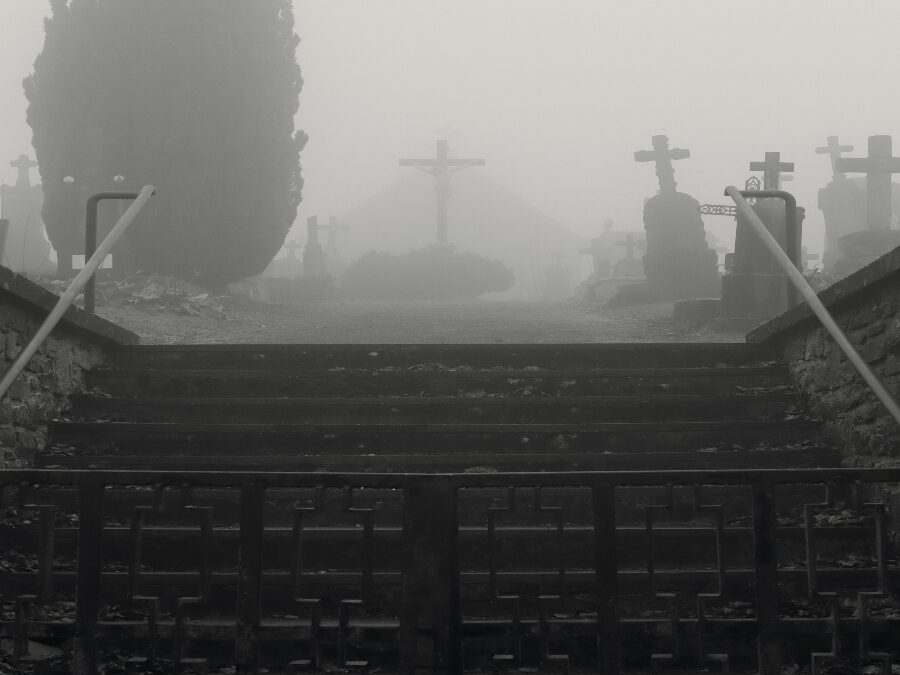
Louis liked the name: Prospect Cemetery. As if its prescient eighteenth-century builders had known that one day college boys would come there to look for one-night boyfriends.
Louis himself found no prospects in Prospect Cemetery. He tried but they didn’t find him pretty. He sat on the branch of an apple tree and relished the collective ruckus of their pleasure. They didn’t mind; he cleaned up after they left.
One day, he lingered on the trash of the boy he loved but couldn’t have. Gus Pitman, senior, kinesiology. He wanted to pocket Pitman’s condom, he longed to eat the leftovers of the pizza that Pitman had bitten into with his perfect teeth.
Pitman actually talked to Louis one night: he zipped his trousers up, clapped Louis on the back, and asked, “How’s it going?”
Louis replied that he hated winter nights.
“I guess I’ll see you around,” Pitman said as he stood there shirtless and smoothed his ginger stache down with his thumb.
Back in his dorm, Louis locked himself in the bathroom and cried. His tears, hot with delight, made him crave apples.
On winter nights when Prospect Cemetery was full of snow and empty of boys, Louis stayed in his bed and pictured framed photographs on his room’s bare walls. In those photos, he was married and had a husky by his side. Pitman’s favorite breed. Louis always threw the trash away: he never brought the condom home, he never ate the crust. Louis may have seemed ugly to the cemetery lover boys, but he believed in consent.

by Robert Garner McBrearty | Oct 13, 2022 | contest winner, flash fiction
Maybe I was twenty-one or so, somewhere around there, young anyway, and I don’t remember much about where this all took place, but our teacher sat on his desk and read us the magnificent one-sentence story “The Dinosaur” by Augusto Montessero of Guatemala, which goes: “When he awoke, the dinosaur was still there.”
We all thought it was the best one sentence story we had ever read, not that we had read so many great one sentence stories. One of our classmates, a lifelong misanthrope, thought it would be better if the sentence read “When the dinosaur awoke, the man was still there.”
The teacher gave him a dull little smile, then told us he wanted us to use the reporter’s questions to flush out the story. At first, to give us the idea, he asked: Who, for instance, was the man? Did he have a name? What did he look like? Then we all chimed in, calling out from our circle of chairs: Was he hairy? Did he have a scar on his face? Did he carry a spear? Was there a mate waiting for him to bring home the meat? Has he been thrown out of the tribe? Was he some sort of loser?
What kind of a dinosaur was it? Was it green or brown? Did it have a hump? A bad leg? Did it get along with its fellow dinosaurs? Was it lonely?
Why hasn’t the dinosaur already eaten the man? Are they friends? Is it like a one-time deal or do they always hang out together?
Where was this taking place? Were there some hills around, a swamp, or maybe some lava flowing in the background? Yes, for sure, lava. Lava was cool. A story can always use some lava. Right, more lava.
Okay, our teacher said, maybe don’t get too caught up in the lava.
When is this happening? Are the dinosaurs about to die off? An asteroid about to hit? End of the world? A new age coming?
How did this all come about, this man, this dinosaur, this moment in time?
So we went off to do our scribblings, the thirteen or so of us, seven guys and six girls, and there isn’t much to say about us except that we were mostly drunks and louts with artistic but criminal dispositions.
The next week we brought our stories back with all the who’s and what’s and where’s and when’s, and we read them, one by one, and we chuckled at our attempts to destroy the story, but we all agreed, unanimously except for one holdout, our misanthrope, that the original was far superior to our laborious efforts and that “The Dinosaur” still stood tall and would remain for all time a perfect one sentence story.
Our teacher sat on his desk, his dark trousers not quite long enough to cover his frayed but clean white socks. He sighed and said, yes, yes, you’re right. It was perfect before. It always will be.
In that moment, with his frayed socks and thin ankles, he looked more tired and old than I had noticed before, and I realized that we knew almost nothing about who he was or where he had come from, or when or why he had started teaching. Was he married? Did he have children? What did he do on the weekends? Did he sing in the shower? Did he ever get drunk? Had he ever wanted to do something else with his life? But it came to me that maybe it was better if we didn’t know. He was just our teacher.
So we, my friends and I with our artistic and criminal dispositions, set out to write the perfect one sentence story, occasionally, just maybe if we were feeling particularly effusive, knocking out a whole paragraph, though our classmate, the misanthrope, went mad writing anti-social haikus that insisted on using the wrong number of syllables.
All in all, it’s been a miserable life. We break laws with abandon, live in and out of jails, lie down in mud and squalor, and when we open our eyes, the dinosaur is, of course, still there.
by Fractured Lit | Oct 11, 2022 | news
1st Place: Tiny Little Goat by Jasmine Sawers
Admittedly, I am a sucker for a funny/sad story that succeeds. It’s a rare beast, as the line between comedy and tragedy is a treacherous one indeed. In “Tiny Little Goat”, one of the shorter stories on the shortlist, I was thrilled by the writer’s darkly humorous use of imagery and metaphor, and I was deeply impressed by how skilfully and quietly this delicate story made me care about the grief-saturated narrator.. Here, a broken love story lives entirely beneath the words, and the reader is entrusted to know it. Masterfully crafted and with a true miniaturist’s pen, this is a surreal and yet all-too-real story about the most lethal kind of heartbreak, a story about not being able to let go. Every sentence, every word, fights for its life. There are many lines that made me laugh aloud, and yet the effect of the story is tragic. The story is compressed so much, yet the heft of it is enormous. I found this weird tale of a character with a tiny goat stuck in their heart as a perfect model of what the flash fiction form can accomplish. ~Meg Prokrass
2nd Place: Boy by Tochukwu Okafor
“Boy” is a breathless one-sentence story that pushes out like a train with its unstoppable narrative flow. It’s a story about being stuck in one’s role and it’s also a story about learning from what we grow up with and quietly bursting out of that prison. It has an ambitious reach and feels as much like a film or novel as it does like a flash. So much of the brilliance in this story resides in how the writer makes the reader feel deeply confided in. I found myself fascinated with the brilliant way this story is told as well as with the unforgettable characters, that leap off the page and unsettle the reader. I am also a sucker for a coming-of-age flash with a happy ending so well earned. ~Meg Pokrass
3rd Place: A Middle Finger Flipped on a School Bus by Davon Loeb
“A Middle Finger Flipped on a School Bus” is a mysterious story and one that I kept rereading as a way to remain lost again in its spell, to linger there just a little bit longer. It’s the story of a teacher who befriends a juvenile outsider, who takes them under his wing. It is also a story of the blight of childhood and how the most difficult children are ultimately the most lonely. I admire the way this writer shows us that two bruised souls will sometimes, even in the most unlikely circumstances, connect in such a way that we feel it may save a life, or possibly two lives. This is a story about being authentically seen. It is a deeply beautiful story. ~Meg Pokrass
Shortlist:
- Attaboy Louis by Shastri Akella
- Mother’s Keeper by Vincent Anioke
- Before by Joy Baglio
- What Will We Do With All This Grief by April Bradley
- The Good Hours by Desiree Cooper
- Shore by Rebecca Entel
- No Rhyme Nor Reason by Jude Higgins
- Castaways by Kathryn Kulpa
- A Middle Finger Flipped on a School Bus by Davon Loeb
- Horse Poor by Alexander Lumans
- Flight Path by Fiona Mackintosh
- Out from Behind a Rock by K.C. Mead-Brewer
- More Than an Acquired Taste by Shareen K. Murayama
- Boy by Tochukwu Okafor
- Undercurrents by Gillian O’Shaughnessy
- All You’ve Heard is True by Melissa Ragsly
- Valentine Springs by Daniel Rodriguez
- Tiny Little Goat by Jasmine Sawers
- For Better, For Worse by Kathryn Silver-Hajo
- Fat Man by Andrew Stancek
- Gregor Mendel Never Knew My Father by Kristin Tenor
- Matthew’s Ninth Birthday by Anamyn Turowski
- If Daphne Still Had a Mouth by Nora Wagner
- The Boy Bandit by Sasha Wolff
- Saltwater Dog by Vivian Zhu
- Mr. Ambrosio Is an Idiot by George Choundas
by Diane Kraynak | Oct 10, 2022 | contest winner, flash fiction
The love story starts here.
I am dreaming of Orlando Bloom when I’m awakened by an icy poke into my bare shoulder. It feels like a cold bony finger pressing deliberately into my flesh. Flurries swirl outside, bathing the room in a white glow. I catch my breath. I should panic: I live alone; there’s no one here. I awake long enough to decipher the situation and exhale, pulling up the down comforter to my chin and snuggling deeper into the pillows. “Thanks,” I say, closing my eyes. I’m thanking my ghost for waking me up because, of course, who else would it be?
For the past month, I’ve been convinced I have a ghost. It started with a pile of books left on my doorstep. A doorstep at the top of the building, at the end of the hall, nowhere near anyone. They are random books with no discernible connections: medical school study guides, a coffee table book on Greek history, an illustrated tome on trains, Irish folklore, and an audio CD on Harry Truman. The books likely came from the apartment lobby: discarded by vacating tenants, snuck onto the shelves while hoping no one noticed. I talk to the apartment manager about it. He suggests it was an apparition. “We do live next to a graveyard,” he says.
There are other things: a magnolia seed bud left on top of my morning newspaper, although there are no magnolia trees around the apartment. Items go missing – scissors in particular – and reappear. The phone rings in the middle of the night with Bruce Springsteen or Aerosmith on the other end. There was even some chain rattling. I tell my ghost that it’s trite and he can do better.
“Orlando,” my friend Rachel says when she hears about my nocturnal visitor. “Your ghost’s name is Orlando.”
“How do you figure that?”
“You were dreaming of Orlando Bloom before you woke up.”
“That makes sense.”
The adjacent cemetery has a self-guided walking tour, marking the interments of local famous midwest persons. I have the guide and wander around the markers. I’m looking for the Chinese headstones. The brochure tells me these are unusual because at that time the Chinese usually sent their dead back to China for burial. I march toward the designated area and feel an urge to look left. I stop cold. Protruding from the earth is a gray granite slab, with “Orlando” written across its shiny face. Was it a coincidence? I’m traipsing around a cemetery and suddenly Orlando appears. It has to be him. He exists.
I am smitten on the spot and hopelessly devoted. I comb through archival newspaper clippings on microfiche for his obituary. I piece together his life. Where he was born, where he died. Where he went to school and what he majored in. The librarian at his school finds him in the yearbook but he didn’t pose for a picture. He is, in my head, a tall, gangly twenty-year-old, with chocolate brown eyes and a mop of dark curly hair. Truth is, I have absolutely no idea what he looked like.
I learn he was deaf. That he committed suicide. The librarian tells me suicide was common in those days for people with disabilities. I convince myself it was an accident. I decide he had a toothache and drank carbolic acid for the pain or treatment. One day, at dusk, out of the corner of my eye, a figure walks along the cemetery fence. Dark pants, white shirt, dark hair. I blink. He is gone. Did I see someone, or was the twilight mist playing tricks on me?
The thing with hundred and thirty-year-old ghosts: you can make them up. There’s no context and no one around to refute you. I talk to him, feel his presence. Orlando is real: loved into existence. I am vaguely aware I am skirting the edges of sanity.
Another ghost appears. A living breathing man of my past. He’s half a world away in a Middle Eastern desert. He, like Orlando, is a disembodied spirit. He, unlike Orlando, enters my life with instant messaging. “You haven’t changed a bit,” he says, winking.
I’m smitten on the spot and hopelessly devoted. I dive in, trying to remember a boy I barely knew thirty years ago. I recreate him through old photos and yearbooks. He is real: loved into existence.
The horror story starts here.
I fuse the two men: attributing the made-up qualities of Orlando to the real person in the internet ethers. My runaway mind fabricates, blends, imagines; I create the perfect person. Neither man is real.
I’m caught up in the idea of being in love and the idea of being in love is so strong I don’t see anything else. My normally astute radar breaks down and I miss the real cues. The real man turns out to be a bad man. I find myself sliding down the wall, collapsing in a puddle of tears, with a crippling stabbing in my chest.
Suddenly, I am surrounded by ghosts. A gang of idealized lovers bearing shame, embarrassment, and humiliation. How many more were there? Crushing on cute guys I didn’t really know, so I made up personalities for them. How many awkward encounters? Fumbled conversations? The relationships I misread, or so desperately wanting it to work out that I overlooked things. Refused to see them. Couldn’t see them.
If I had to do it over, I’d pick the unknown man, the phantom presence whose reality can’t and never will hurt me because he’s dead. He’s not flesh and blood, not able to do me physical harm. He can stay in my imagination where he is who I need him to be.
by Rachel O'Cleary | Oct 7, 2022 | contest winner, flash fiction
This is the third year that she has haunted me. She is pale and slightly shimmery, as if brushed with frost, but her cheeks are stained with the soft pink of little girls her age.
She trails behind the other children as they jam their feet into snow boots and search for missing mittens. She holds her hand out to me, pudgy fingers stuck together inside an abandoned glove she has rescued from the floor, and looks down with greedy eyes at the smallest pair of boots, the ones that no longer fit my real children. I blink, and I see myself there with her, faded like she is, tired and swaying as I force her wriggling feet into them.
I clench my teeth and brush past her, following the children into the snowy yard. I help them roll hundreds of snowballs, teach them to aim at each other’s bodies – not faces – and together, we dig a tight tunnel through the mountain of snow I’ve been shoveling off our driveway for weeks. Sweating from the effort, we curl our bodies into the arching burrow. We’ve judged it perfectly – there is just enough room for us three, and it is snug and warm inside despite the cool trickle of snow from our hats melting down the backs of our necks. Still, I can feel her pale eyes on me. I crane my neck to look out the end of the tunnel and find her standing in the white-flecked wind, shivering, that one thin glove still stretched awkwardly over her left hand.
She never comes too close, never speaks. She used to wake me repeatedly in the night, like a baby, but not by crying. I would sit up in bed to the sensation of her staring. Her eyes are steady, grave, mature. They are not the eyes of a child. They are mine. Exactly mine.
She haunts him, too, but she doesn’t follow him the way she does to me. The way the others used to stalk me if I strayed so far as the toilet, back then. The way they used to watch me through the steamy glass of the shower, and tug at my limp hand in the middle of the night. She comes to him in glimmers: chasing the other children into the surf on unsteady legs, sitting between them in the back of the car, or just staring at the four of us, slotted comfortably together like a jigsaw puzzle on the sofa on Christmas morning.
“I saw her in those places, too,” I told him, when he confessed this to me.
And I did. I saw her screaming, red-faced, as I ran to drag her out of the waves. From the water where I bobbed weightlessly, I watched my other self hold her hands and dip her toes into rock pools while keeping half an eye on the surf, waiting nervously for the sight of two distant bobbing heads. I saw her squished into the middle seat in the back of the car, arms flung out across the faces of her yowling brother and sister. I saw her ripping paper from a third too-large pile of presents under the Christmas tree.
“You know I don’t resent you.” He says this with a whisper of sweat on his brow and lips pursed in concentration. He says it in a rushed, clipped voice, the exact same inflection every time. He says it like a prayer he learned to recite years ago in Catholic school.
I leave the children behind in the tunnel and go into the house. As I spoon hot cocoa mix into cups, she counts the mugs. Peers into the tin in my hand. There is enough there, her eyes say. Isn’t there enough?
I slam the tin on the countertop and open my mouth. Close it again. Squeeze my eyes shut tightly. Finally, I nod.
There is enough of nearly everything, I want to tell her. There’s enough cocoa. Enough boots. Enough love. Just not enough of me.
But I don’t say any of that. She already knows.
She stares at me openly, now, and I feel something pulling at my chest. Some pulsing, substantial part of myself is being torn away from me, slowly. The pain is eye-watering, but I bite my lip and hold eye contact with her. I stare at her while the slamming door sets the walls to shivering and the thud-thud-thud-thud of heavy boots dropping to the floor echoes in from the hall. My children call to me from a great distance.
“Mom!”
“Mom!”
“Mom!”
I finally turn away from her and see their damp red faces, staring. I look at them for a long moment without recognising them. Absently, I seat them at the table and give them their cocoa, my hands shaking, slopping the brown liquid on the table.
When I turn back to the kitchen to find her again, she’s not there. She’s not scraping her tiny finger along the rim of the empty tin, smearing chocolate residue across her thirsty lips. She’s not shivering, or dripping melting snow on the kitchen tiles, daring me to help her. She’s gone, and she has taken something with her.
I rush to the window. There, amidst the cloudy white and anemic gray of late afternoon, two people stand facing one another. The other me has bundled her into a red coat and fluffy mittens. She takes the girl’s hand and together, they turn and trudge away, leaving nothing behind, not even footprints in the snow. I stand at the window, watching them walk away, watching it go dark. I stand there until I can’t remember who I was looking for out there in the first place.
by Megan Bounds | Oct 3, 2022 | micro
No time left in Jackie’s thumbs. They died before the rest of her, dangled precious on jagged hipbones, in and out of false pockets. Useless. Amputation was out of the question. Her son moved in to lift cartons of milk, boxes of cereal, orthopedic pillows. Take out the trash. He massaged the place where her dead thumbs met palm, but the joints did not crack. They did not speak at all. Jackie blew on them at night; she soaked them in water for five hours at a time; she drenched them in oil; dressed them with moss; licked them like a cat. She flicked her wrist, threw them at the wall, but nothing: no feeling, no pain or forgiveness or hunger. She remembered when her thumbs used to be hungry. Sometimes before, she would wake, and her thumbs would crawl off the bed, itching for moisture at the window, like worms in the dirt. They had always lived faster. Now, Jackie’s body skipped every other beat to catch up. She hummingbird-jittered around the house, thumbs trailing a wingspan behind. On the last night, her son watched her wear grooves in her bedroom floor; this time he couldn’t tell if her thumbs led or followed.
by Fractured Lit | Oct 3, 2022 | news
- Attaboy Louis
- Mother’s Keeper
- Before
- What Will We Do With All This Grief
- The Good Hours
- Shore
- No Rhyme Nor Reason
- Castaways
- A Middle Finger Flipped on a School Bus
- Horse Poor
- Flight Path
- Out from Behind a Rock
- More Than an Acquired Taste
- Boy
- Undercurrents
- All You’ve Heard is True
- Valentine Springs
- Tiny Little Goat
- For Better, For Worse
- Fat Man
- Gregor Mendel Never Knew My Father
- Matthew’s Ninth Birthday
- If Daphne Still Had a Mouth
- The Boy Bandit
- Saltwater Dog
- Mr. Ambrosio Is an Idiot
by Breana Harris | Sep 29, 2022 | flash fiction
The other moms at the beach are skinny and sharp, all oiled angles and monochromatic bikinis. Mira and I don’t speak to them much.
“Beautiful day,” says the one under the striped umbrella. We cut close to her to reach the place where the sand turns wet and black.
“Yes, not bad,” I say in return. We exchange tight smiles.
Mira is twelve. Like me, she is round and white, her long blonde hair falling in leftover ringlets from yesterday’s poolside birthday party. Her suit is a contrast of pink and blue, and she wears her pearls–always, her pearls–roping double around her neck. She wanders ahead of me, laughing in the clear light, no cover for her legs. The angled women on beach towels hold their breath at her audacity. They worry for their sons.
She looks at the other children playing in the tide. “Am I supposed to talk to them?”
I squat on the damp beach and burrow into the smoothness with my hands and feet. “Honey, you are not supposed to do anything.”
This answer satisfies her, but she approaches them anyway. She tilts her head once at me and begins a crumbling path of footsteps toward the others. I worry for her. A boy with pale eyes and protruding ribs laughs at the sight of her. He pokes his friend in the shoulder and claps his hands like a seal. Arf arf arf.
Mira doesn’t understand, because that’s not how we would describe a seal in our household.
If I could command the ideas that linger in my brain, unable to be spoken in the language I once absorbed so easily, I would write my child a dissertation on the ocean. I would know the words to describe the darkness. I would tell her tales of salt-encrusted starfish, jewel-like seahorses among the underwater tangleweeds, katana-edged rock walls, sticky-moss shipwrecks, and monsters with eyes that glow brighter than the sun.
I would tell her that her grandmother’s grandmother was born of the cold that comes from deeper in the depths than land creatures could ever go. A holy sort of freeze. There’s no reason to be afraid of it. If you can freeze, you can do anything.
I cross my legs, half-buried in the sand. The sun is so bright that I can hardly make out the children. I should have sunglasses. A person would have sunglasses on a day like this.
Before Mira was born, my husband tried to walk me through the ordinary objects I should know. This is a dishwasher. This is a hat. This is a pushcart thing that spins razors and cuts the grass. These are shoes, some for walking and some for making it harder to walk. This is a car. This is a dog. This is a hairbrush.
Okay, we have that one.
After she was born, he decided that he didn’t like her. He was upset that she was so fat–aren’t all babies fat? I asked–and he didn’t like that she stared at him with great bulbous eyes. He swore that they were golden in the light, just like the giant blue mackerel he caught with his father when he was a boy.
Two little girls, both spaghetti-like and full of teeth, giggle and pinch the small bit of fat on their bare midsections, comparing their bellies to hers.
The first boy grabs a handful of her underarm. “Is that your blubber?” he asks. “Are you gonna swallow us like a whale would?”
“Ow,” says Mira. She takes her arm back and sighs, confused.
Another mom towers over me. Her silhouette blocks the light. I can see she has sunglasses, large and plate-shaped, like she is supposed to.
“Maybe you should find a less crowded part of the beach,” she tells me. She frowns at the way I am sitting. I know it must be unordinary, not like a person at all.
If I could find the words, or imprint the memories, I would tell my child that men cannot breathe underwater. It’s easy to forget, because men will act as if they can do anything. But one sharp inhale, and their fragile lungs fill up until they are fit to burst. Their blood-bruised veins rise to the surface in delicate paths along their skin, and they look at you with surprise before they die. This look will make you feel more beautiful and powerful than any other. You will see yourself, as if from the shallow surface of the water, an indestructible queen of alabaster and spun silk, with lips like poison flowers and breasts like impassable peaks. I’m so cool, you will tell yourself. I am so cool.
The boy has a seashell, pointy and white, and bigger than his hand. “It’s a present for you, Mira,” he says.
She reaches out to accept it, and he lunges for her palm. A cut to her Venus Mound starts to bleed, and the blood is too black. He stares at it in a kind of horror, but he laughs.
After a minute, he notices that his grip on the shell has caused his hand to bleed, too. He shows her the bright red streak between his fingers, and they snicker together.
Mira backs further into the waves. He follows, entranced, while the others look on. When the saltwater reaches their shoulders, I can hear one of the girls call out to him. His name is Tommy or maybe Brandon or Ian. All of their names sound the same to me.
My daughter’s blond ringlets float for a moment, then she disappears entirely. The boy follows. The moms start to scream, and I can see them running for the ocean, the lean meat of their legs pumping in the crashing water. One even dives into the foam. But Mira and the boy are gone.
I stay buried in the sand, like a beached orca, silently beaming with pride.
by Ellen Weeren | Sep 26, 2022 | micro
Children play on street corners until the lights grow dim and the stars are visible like pinpricks on a bulletin board. Dinner is an any-hour activity of bologna sandwiches and watered-down Kool-Aid. There’s no urgency for the children in getting home at a particular time unless they want to watch the news. They don’t. They’re more interested in what’s coming than what’s been and get their futures told from paper fortune tellers that flit opened and closed like a sparrow’s wings. The ones where they control the options because they fill in the answers themselves. Lift one flap, and their old dog dies, another, and they’ll find their prince. Even without a fancy wedding dress, their party will be the best in town. Unfortunately, a spill of rain can ruin the game and send the children running home. The blue-lined paper melts, the pen-spelled words bleed. Not everyone gets a chance to see their futures unfold. But then, the drunk old witch on the corner of This Street and That Road promises them that when Saturn and Jupiter are in conjunction, they will win the lottery. She doesn’t tell them that conjunctions only happen once every twenty years because she doesn’t remember all the facts. As their lunch money turns into lottery tickets, their futures turn the corner into their parents’ lives.
Originally published in Five South
by Benjamin Niespodziany | Sep 22, 2022 | micro
Once a week a truck driver drove down our street. Stuck to the sides of the semi were two television screens. Massive plasma bastards. The screens always promoted something new: shoes, video games, the dentist running for president, carrying wisdom teeth in a bag. The truck driver drove all over the city and whenever he passed down our street, we stopped to watch a commercial, glad to see an ad, to wave the man onto that which the route acknowledged. When the truck driver’s wife grew sick, he drove slower. He played ads for cancer, for grave sites, lifeless skies, forever blues. A seagull soaked in oil. How to know that sorrow. One day, he drove down our street and his televisions were draped in black cloth. We wheeled our televisions against our windows, out into our yards, our screens facing his way, so that when he passed, he saw canyons and snowfall, galaxies and beams, sunsets and moose. None of us had ever seen him drive that slow.

Recent Comments