by Fractured Lit | Nov 27, 2023 | contests

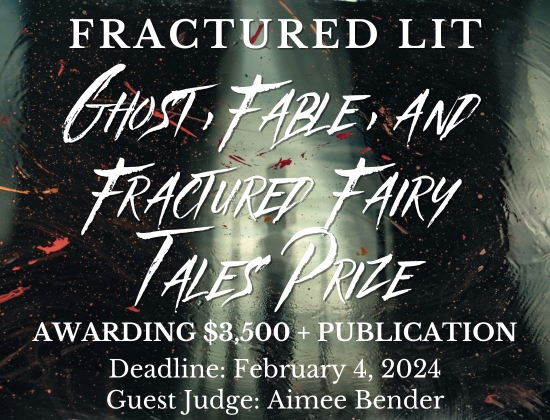
judged by Aimee Bender
December 1 to February 04, 2024
Add to Calendar
submit
This contest is now closed. Thank you to everyone who submitted! We can’t wait to send our shortlist to Judge Aimee Bender!
2023-24 Winners:
1st Place: To the Tower by Skyler Melnick
2nd Place: The Desert Sound by Mikhaela Woodward
2nd Place: The Pebble and the Witch by Emma Li
3rd Place: Our Lady of Clean Kitchens by Joseph Hernandez
We invite writers to submit to the Fractured Lit Ghost, Fable, and Fractured Fairy Tales Prize from December 01, 2023, to February 04, 2024. Guest Judge Aimee Bender will choose three prize winners from a shortlist. We’re excited to offer the winner of this prize $3,000 and publication, while the second- and third-place place winners will receive publication and $300 and $200, respectively. All entries will be considered for publication.
Fractured Lit is looking for stories of ghosts, fables, and fractured fairy tales in 1,000 words or fewer. Whichever tradition you choose, make sure you find a new way to approach it, to twist and discombobulate it, so it pushes us away from the mundane and into the strange or uncanny. Transport us from the here and now to a new land of discovery, a fresh way of being entertained that embraces all of the ways we show our humanness.
Aimee Bender is the author of six books: The Girl in the Flammable Skirt (1998), which was an NY Times Notable Book; An Invisible Sign of My Own (2000), which was an LA Times pick of the year; Willful Creatures (2005), which was nominated by The Believer as one of the best books of the year; The Particular Sadness of Lemon Cake (2010), which won the SCIBA award for best fiction, and an Alex Award; The Color Master (2013), a NY Times Notable Book for the year; and her latest novel, The Butterfly Lampshade (July 2020), which was longlisted for the PEN/Jean Stein Award. Her books have been translated into sixteen languages. Her short fiction has been published in Granta, GQ, Harper’s, Tin House, McSweeney’s, The Paris Review, and more, as well as heard on PRI’s “This American Life” and “Selected Shorts.” She lives in Los Angeles with her family, and teaches creative writing at USC.
We hope you’re inspired to write that story that has been gnawing at your subconscious, that’s ready to arrive into the world, whole and thrilling. These are some of our favorite stories to read each year!
guidelines
- Your $20 reading fee allows up to two stories of 1,000 words or fewer each per entry-if submitting two stories, please put them both in a SINGLE document.
- We allow multiple submissions-each set of two flash stories should have a separate submission accompanied by a reading fee.
- Please send flash fiction only-1,000 word count maximum per story.
- We only consider unpublished work for contests-we do not review reprints, including self-published work (even on blogs and social media). Reprints will be automatically disqualified.
- Simultaneous submissions are okay-please notify us and withdraw your entry if you find another home for your writing.
- All entries will also be considered for publication in Fractured Lit.
- Double-space your submission and use Times New Roman 12 (or larger if needed).
- Please include a brief cover letter with your publication history (if applicable).
- We only read work in English, though some code-switching is warmly welcomed.
- We do not read anonymous submissions. However, shortlisted stories are sent anonymously to the judge.
- Unless specifically requested, we do not accept AI-generated work.
The deadline for entry is February 4, 2024. We will announce the shortlist within ten to twelve weeks of the contest’s close. All writers will be notified when the results are final.
Some Submittable Hot Tips:
- Please be sure to whitelist/add this address to your contacts, so notifications do not get filtered as spam/junk: notifications@email.submittable.com.
- If you realize you sent the wrong version of your piece: It happens. Please DO NOT withdraw the piece and resubmit. Submittable collects a nonrefundable fee each time. Please DO message us from within the submission to request that we open the entry for editing, which will allow you to fix everything from typos in your cover letter to uploading a new draft. The only time we will not allow a change is if the piece is already under review by a reader.
OPTIONAL EDITORIAL FEEDBACK:
You may choose to receive editorial feedback on your piece. We will provide a two-page global letter discussing the strengths of the writing and the recommended focus for revision. We aim to make our comments actionable and encouraging. These letters are written by editors and staff readers of Fractured Lit. Should your story win, no feedback will be offered, and your fee will be refunded.
submit

by Kathryn Kulpa | Nov 27, 2023 | flash fiction
But not really. It’s a nickname, something my sister used to call me. You wouldn’t know my real name. He never did.
I wasn’t the first one he killed. I wasn’t the last. Not quite. I was part of the long fade but not the final coda. He was shooting for 100. I was #94.
He liked to brag about how smart he was, how dumb the cops were. Of course, he started in the seventies, before DNA evidence. He told me about #21, found in a hastily scooped-out roadside ditch. Pants pulled down to her ankles, like a candy wrapper ripped by an excited kid who can’t wait for the first bite.
Struck by lightning, police decided. He laughed for days.
He told me this while his hands were around my neck.
I got an eye for them, he said. The girls nobody misses.
* * *
When we were kids, my sister and I fell through ice in a February pond. We were skating—pretend skating, because we couldn’t afford real skates.
That might have saved our lives. Ice skates are heavy. They can’t be kicked off the way-too-big sneakers can. I kicked my feet free, grabbed my sister’s hood, and swam to the edge of the pond, where a tree root poked through feathery snow.
One hand holding that tree root. One holding my sister’s hood, a quilted white parka with fake fur trim like a half-drowned squirrel.
In so many nightmares after that, I felt the fabric slide from my hands, saw my sister’s face sink under black water.
But that didn’t happen. Hold on tight, she said. And I held on.
It was my fault the ice broke. We were playing Olympics, and I had to try the triple axel. My little sister watching me like she was taking notes on who to be. I jumped and twisted and saw her face fly by once, twice, saw her eyes get wide, and just for one moment, before the ice cracked, I was flying.
* * *
I could fill a book with them, he said. All my Jane Does.
His arms were around my neck and I grabbed his collar and he laughed and said it was cute that I fought back, but he had no idea who I was, no idea I could fly, no idea I was the one who’d finally take him down, the hair I pinched from his head held in my hand, my fist squeezed tight around it. He had no idea how hard I could hold on.
by Jiksun Cheung | Nov 20, 2023 | flash fiction
In the time that my mother has been missing, the skies have turned a gray, roiling mass. The radio is calling it the most violent typhoon to make landfall in thirty-two years.
We’ve looked everywhere, and there’s nowhere else left except here, in the ruins of the abandoned Wah Fung housing estate, where my mother and I once lived in a tiny room on the sixth floor.
In the clearing outside, a squall tears at my flimsy raincoat and drags an old banyan tree snapping and splintering to the ground. A battered No Trespassing sign flits overhead and ricochets off the crumbling façade. I find an embroidered shoe near the entrance, swirling in the ankle-deep floodwater like a goldfish in the murk.
“Ma! Is that you in there?”
In response, there is only the whistling of the wind.
What on earth could she be doing here—and why now?
I try to recall the last time we were all together: Maggie, the boys, me, my mother, sitting around our dining table. The food getting cold. The nursing-home pamphlet opened to the page where an elderly couple beams at the camera, surrounded by family.
“If that is what you have decided,” she says. And then, after a pause, she adds: “You always choose what is best for your family.”
She doesn’t smile. She doesn’t pat my hand to reassure me that she understands. She doesn’t touch the fish cheek I place in her bowl. But her words slide between my ribs so that even after Maggie, and I clear the dishes and the boys are fast asleep, even after my mother quietly shuts the door to her room and turns off the light, all I can hear is: “You always choose what is best for you.”
* * *
I stumble through the flooded corridors, flashlight in hand, until I see the old provisions store, tucked beneath the stairwell, where my mother used to work.
The shutters on one side have collapsed, revealing a row of empty shelves. I think of my mother stacking tins of oily fried dace, her thick, black hair in a knot, the radio behind the counter crackling a Teresa Teng love song. She pauses in front of the radio before changing the channel and then tells me to finish my homework before she locks up.
I find the other shoe on a landing about halfway up, waterlogged and torn at the sole. The whistling continues unabated.
* * *
I step into my childhood home at the end of a long corridor on the sixth floor. The room is empty, save for the candle on the floor, painting the peeling walls a flickering orange, and the figure by the window struggling with the handle.
“Ma—are you hurt?” I say. “What are you doing?”
She is surprised to see me, but then her expression hardens. “It’s rusted shut,” she says. “Can’t get it open.”
“Come on, Ma.” I put an arm around her shoulder, but she pulls away.
“Just let me do this,” she says.
“Come on—we shouldn’t even be here.”
I take her by the wrist, but even now, I’m surprised by her strength. She wrenches free and bangs a bony fist onto the rusty handle. A cry of frustration escapes her lips.
“Ma—have you lost your mind?” I shine the flashlight on her hand, where an ugly purple blotch is already pooling beneath the skin. “We can talk at home.”
“I didn’t ask you to come.”
This is what happens when we talk: words fly out of our mouths, but we never seem to understand each other. “What do you want, then, Ma?”
“Just—help me,” she says. “Please.”
Outside, the rain surges like waves on rock. The whistling is louder, too, coming from all directions, rising and falling, as if seeking harmony but never quite finding it. I realize she’ll never leave this place until she does whatever she’s here to do.
“Fine,” I say.
I raise the heavy flashlight and bring it down sharply on the handle. Once, twice. A crack, and then something gives way. The window explodes, ejected by a mighty pressure. The candle goes out. And I remember.
The day of the big typhoon, thirty-two years ago.
Ma says the store will be flooded, so I wait for her under the dinner table, wrapped in a thick blanket. The wind whistling all around. Suddenly, the window bursts open, and I’m engulfed by a sound that I can feel in the pit of my stomach, a deep thunderous drone: beautiful, like the long, solitary call of a blue whale, but also infinitely terrifying, like the howl of some unfathomable beast, so loud that even the floor shakes.
I curl up into a ball under the blanket and call for her, not realizing that she is already beside me.
“I’m here,” she says, pulling me deep into her arms. “It’s all right. I’m here.”
* * *
My mother listens now, silvery-white hair plastered to her face, enraptured by the haunting harmony of the typhoon barreling as it did a lifetime ago, along winding corridors, between cracks in the walls, and through the room on the sixth floor with the open window.
She finds my hand and clutches it, now and in the past. We listen for a while.
“I’m here, too,” I say.
“I know.”
*Originally published in And If That Mocking Bird don’t Sing: Parenting Stories Gone Speculative

by Deesha Philyaw | Nov 16, 2023 | flash fiction
Does Love exist?
Is fat meat greasy? Cuz ain’t no way I could’ve fallen so hard, so fast, so far, by myself.
Rewind that.
I didn’t fall in love. Like Toni Morrison said, I rose in it. If only for one night. I levitated for that brother with the high-top fade, tired eyes, and pretty smile. That first night, we worked it out, strangers on the club floor. Some Bobby Brown, some Chubb Rock, a little Jody Watley, the chaos and black steel of Public Enemy, and then Miss Jackson (cuz I’m nasty and he is too). We grinded, we Reeboked, and we Cabbage Patched until sweat plastered my hair to my face, plastered his shirt to his back. When he pulled me close and murmured, “Can you stand the rain, ma?” in my ear, I didn’t even mind his wet cheek on mine. My panties went damp, too. It was a wrap. You know how it is. And then back to life, back to reality. Lights up. You ain’t gotta go home, but you got to get the hell outta here.
Where shall we worship?
In his car, in the park, in his room when his mama was at work, on the stoop, always, always, in the shadows.
And when shall we worship?
Night and day. After the dance.
And how shall we worship?
However do you want me, however, do you need me, how…
How is Love manifest?
The way it always does: with a Running Man. Storms did come, and I became a Fly Girl. Chasing him, forgetting my mama’s wisdom that what’s for me will be for me.
Rewind that.
I didn’t forget a damn thing. That man’s honeyed tongue brought me to my knees, had me acting like I didn’t have the sense god (my mama) gave me.
Lisa, Angela, Pamela, Renee…he loved us all and not at all. His only consistency was looking at the front door.
Don’t walk away, boy….
So I cold bum rushed Lisa. I sliced Angela. Me and my girls jumped Renee. As if his was a love worth fighting for. As if.
(Pamela was pregnant––yeah, he had a baby on me.)
How can we speak about Love?
Besides calling his mama’s house and cussin’ him out? It took me a while before I could talk about it. Because really, what was there to say? Could I chalk it up to a teenage love if we were nineteen and knew better? Well, I knew better.
Who does Love love?
Nobody.
And what has changed since back in the day?
Not a damn thing. Love is like a bus you been waiting for. Feet tired, ankles swole after working all day. A few buses pass by, but they’re not yours. So you wait some more. Then your bus comes, and finally, you can sit down. Rest your weary. Relax your mental. Exhale. Drop your shoulders. Close your eyes and go anywhere your mind’s music takes you. But it seem like as soon as you settle down good, it’s your stop. Time to go, back to walking.
I ran into him the other day outside the grocery store. He still look good, about the same but with salt and pepper in what’s left of that fade––a b-boy with a round middle in middle age, eyes still heavy like he’s seen too much. Both a survivor and someone you’re lucky to survive. Smile still pretty. He hugged me, his fingers tap-dancing on the small of my back, like old times. Asked me if I got a man, grabbed my phone before I could answer and put his number in it. I ain’t deleted it yet.
And when shall we Love?
On and on til the break of dawn.
*after “The Petoskey Catechism, 1958” by Elizabeth Kerlikowske, and Mahogany Browne’s “A Hip-Hop Story in Lyrics”
by Fractured Lit | Nov 14, 2023 | news
We’ll be publishing 16 total stories from this contest and we’re so excited about Judge Sara Lippmann’s choices! Thank you all for trusting us with your writing!
Grand Prize Winner: For a Short Time Only by Holly Burns
15 Finalists (in alphabetic order) are:
- Pairs by Jennifer Ahlquist
- possible future for our daughter #683 by Carly Alaimo
- Is Now and Ever Shall Be by Alex Bisker
- If we name it Mittens, can we please keep the food delivery bot, please? by Moisés Delgado
- We Mistakenly Think It Keeps Growing by Marilyn Hope
- Candied Lemon by Grace Kennedy
- Intertidal by Ali Mckenzie-Murdoch
- In All The Loveless Places by Jennifer McMahon
- My Mother, the Water Monster by Aeriel Merillat
- The Girl Made of Dirt by Dawn Miller
- Piel Muerta by Gabriella Navas
- Cheerful by G. Ochsner
- Four by Evan Ramzipoor
- Fullness by Payne Ratner
- Snagging Blanket by Abigail F. Taylor
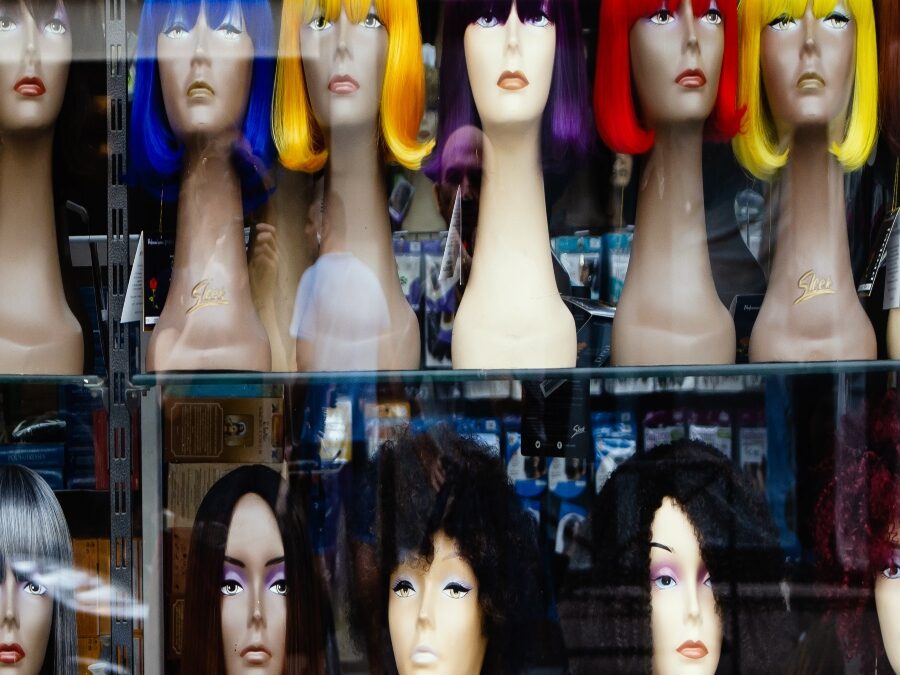
by Hannah Olabosibe Eko | Nov 13, 2023 | flash fiction
One day Neela will run inside and steal me away.
The other wigs roll their eyes. They smell the hope on me—a sticky sweet decay like garbage abandoned in the sun. They believe in Second Girls, not fairy tales.
They did not hear the story I did: how one of us (miracle of miracles!) was returned to her rightful owner and her still warm scalp. My heart recycles the same fantasy like a mad carousel: reunion, coconut oil, the nape of Neela’s slender neck.
The glittering tingle of entry sings a new arrival, and I meet the new customer.
This girl is black, curves of breasts and hips where Neela was one straight line.
Her hair strangled tight into a ponytail under a baseball cap pulled low.
She darts towards the back wall, littered with barrettes and scrunchies.
The owner of the store yells at her back.
All purses to the front!
The girl surely saw the many signs, fat black marker on discarded cardboard.
I know just enough English to understand:
No Returns. No Loud Talking. No Big Bags.
No Children. No Exchanges. No Gum.
The owners of Beauty 123 may as well as next write: No You.
The girl makes her way to the register, a tornado.
Brown eyes flash, shoulders set in proud perches.
Only skin color connects Neela and this girl: darkest of brown like pregnant soil or the cave of a womb. Neela was gifted an inconspicuous nose, hazel eyes, and me dripping down her back in thick ropes of shine. Her skin; her main demerit. She dreamed of Fair & Lovely lotion raining from the sky. She dreamed of different parents and baths of bleach.
This girl holds her darkness with something close to pride.
She dumps her bag onto the counter, and the owner stuffs it underneath alongside leftover receipts, rolls of pennies, inventory slips gone bad.
Her jaw juts upward, and the diamond stud beneath her lower lip shines like an angel wing,
I am not a thief, she says.
They christened me Malia in an Italian warehouse.
Dyed me a milky purple and sewed me to gauze.
In this store, we are all renamed with tropical breeziness.
Leeana. Cristina. Kaylani and Jade.
Sweet names that kiss the edge of tongues.
These names betray us, here we are: dying under the dead glare of fluorescent light and Cellophane.
No one cares for the names we left behind.
I am the chosen one with heat-pliable waves lifted high onto a peeling Styrofoam head. Center stage. No customer fails to notice my beauty.
They gaze at me with longing, run their hands over my curves when the owner glances away. They pant like children after a lolly. I sense their desire the minute they enter. Then they learn of my price, sulk away as if duped.
No money, no honey, I would say if I had a mouth they could hear.
People think we are free for their taking.
I am even on television now, a black and white recording of the shop’s every move.
Neela would be proud.
She wanted to be an actress, practiced flipping me so I fell in one shy curtain over one eye, but her father laughed.
They are no better than prostitutes, he said, and besides, look in the mirror.
What kind of actress does not shine?
Beauty 123 has four monitors watching the store. As if one day the aisles of hair dyes, shampoos, and paddle brushes will descend from their shelves and flee.
The owner’s eyes track the girl’s every movement with the searing eyes of a hunter.
Even the owner’s hair, a short black bob streaked with grey, is alert.
Like a bodyguard wishing for near-death and glory.
I wonder why this girl, now pondering a wall of relaxers, has not looked at me, not even once. Is she selectively blind? Deliberately stupid?
How can she not desire to know my new name?
Days ago, one tiny girl tried to slip a butterfly barrette into her panties.
Her mother protested the charge, but the owner rewound the tape.
Finally, the girl pushed the yellow plastic forward onto the counter.
The owner used an envelope to skate the butterfly into a trash can, took out her camera as the
girl stood silent. The mother quieted.
The shame, thick as cooking oil.
Outside the door, the mother yanked the barrette girl along.
The owner retold the story to her own daughter, pantomined the barrette girl’s hiding place, the mother’s dramatic arguing.
Her own daughter, a timid thing with bitten-down fingernails, was busily stocking nail polishes on the front counter.
Tiny prizes like keychains and toy-sized lotions arranged to flirt with impulse buyer whims.
The daughter sighed.
C’mon, mom. A barrette? she said before turning back to her task.
The owner jabbed at her daughter’s shoulder.
The surprise of the stab made a polish fall to the floor and shatter in a blue blob of glass.
I understand little of their language, but every lace knows a mother’s disappointment, weighty like a rain-soaked roof.
We all had a First Girl who had a mother.
The owner pointed to the floor, brushed by her daughter so that the girl flinched.
Do you know the sorrow of hair that wishes to cry and cannot?
A sob of fury shoved into each lock?
Some women, like the owner, are just born that way.
The daughter knelt, rubbed at the polish already congealing like a crater.
There is still a stain there, an aftermath of blue.
Barrette girl’s photograph has joined the other shoplifters on a blank space of wall near the entrance. The picture is blurry. She is looking down, the baubles in her hair heavy like anchors.
I try not to feel sorry for her. Fail, try again.
She would learn the lesson elsewhere, probably more harshly.
A girl should never desire more than what she has.

by Amina Kayani | Nov 9, 2023 | flash fiction
The traveler isn’t lonely. The ghosts of dead oceans joined the ship soon after the first onion sprouted in the tin of soil the traveler built in their quarters. The ghosts of dead oceans tell the traveler things like, “That light is giving me a headache,” and “Is it the onions making you cry?” and “You’re so boring, lost in the past. Bring us the old future.”
The ghosts of the oceans never want to talk about heartbreak. It was too often on their minds. They floated with each other, remembering the feeling of mollusks on their floor, of smooth skin displacing their salt, their first caresses. When the oceans sing, the traveler goes into their room and shuts the door. That kind of longing can be unbearable.
The thing about a voyage to Proxima B is that it will take them 6,500 years. The thing about Proxima B is that only one person is making the voyage. This means that their lover no longer visits them in the evening, but the traveler likes to put their tongue beneath her imagined jaw—the place she directed them on the first night spent.
Even so, they are no good at calculating time zones and often neglect calculating the distance between galaxies. There’s never a good time to call and mend.
“Relationships are all about timing,” the dead oceans tell them, wistful for their old planets. The traveler looks in the mirror at an unaging face. Lost love is more haunting than the ghosts.
In space, stars still look distant. In space, the traveler still extends their fingertips as though they might touch one. In space, stars still look distant. In space, the traveler still extends their fingertips as though they might touch one. The dead oceans tell them, “It’s too late to retrieve the other timeline. Even we are seeking water on this ship.”
The traveler realized too late that when physicists said time was an illusion, they just thought it was interesting to talk about. None of them really believed one could perceive it differently. The traveler felt fooled. They thought, with the right angle on the universe, they might crack open their past from any point in the future, like roots under a sidewalk, rebirthing ancestral seeds.
But they couldn’t crack anything open, not during this drift.
There was a day when the traveler woke up in her bed and kissed her before breakfast. They sang Barry White in the kitchen over pancakes. The day was gray but mostly green.
Looking out the window at Proxima B’s already dead light, the traveler reached out to the ghosts, and for once, the ghosts didn’t say anything. When the star flared, the traveler could have sworn they felt, finally, the moisture of her sigh as they kissed her neck. Her coarse curls against their ears.
by Avitus B. Carle | Nov 6, 2023 | flash fiction
I find my boyfriend’s car parked in front of the Hillside Motel and consider shattering the windows or, at least, peeing on the windshield. But that’s bad for business. Not my business because, technically, he’s my ex-boyfriend and, fortunately, it’s my grandmother’s 80th birthday.
She deserves a granddaughter who can behave, who can do as she’s told, even though I’m neither of those things. Instead of being here at 5 pm like she asked, I’m in front of her usual room at 4.
Instead of Carrot Cake in a white box, I have a Red Velvet in a pink box because I don’t like Carrot Cake, and she knows I don’t, just like she probably knows that my ex shouldn’t be one of her gentlemen callers.
That’s what my mother calls them. Ever since “sperm donor” was revealed to be an inappropriate way for me to introduce my grandfather to my second-grade class.
Her gentlemen callers used to come to the house until my 12-year-old self caught one climbing through my window. My grandmother would later describe him as a man who had “a thing for breaking and entering,” with a wink that haunts me to this day. Then came the motels, though she’s settled on room 28 at the Hillside Motel 5 miles from our house.
I told my ex all this in the car that’s now parked outside my grandmother’s room. Same car he parked outside of our house, when he first met my mother and Ethel. I didn’t feel anything when my grandmother and him talked about football all night, him sitting next to her and across from me at dinner. Her reapplying her lipstick in the mirror, him licking his lips and talking about her delicious pie. How excited he was to dive in, to taste, already ready for seconds and thirds.
I didn’t start feeling anything until I walked him back to his car, expecting to be invited somewhere, but he starts talking about my grandma and how she “gets” him like I don’t, but, just in case, I tell him I do. I do get him, and he says something about needing space and things will be better this way and something about meeting someone else.
“Oh,” and this he says after braking too hard, after I start thinking he’s changed his mind, “let Ethel know, if she needs anyone to taste test her pies, I’m free.”
Maybe this shit-covered bench and melting Red Velvet cake and I all deserve each other. A man, not my ex, walks out of room 28. Between him zipping his pants and the cool air that escapes from the room, I can see my grandmother’s legs rocking. The mole on my ex’s ass like a dab of ink.
“Oh,” the man stares at me. His lip twitches as the door closes. “You must be—”
“Don’t.” It’s weird when they acknowledge me. Worse when they say I look just like Ethel, them smelling like Vicks, my grandmother’s cure-all.
I’m not sure how much time passes. Only that I can see my grandmother’s hand between the curtains. The fog of her breath. She’s really into whatever my ex is doing to her, and I try not to be jealous, but Ethel doesn’t work up a fog for just anyone, and I can’t help but wonder why he never did anything, like he’s doing to her, to me.
A jeep pulls into the lot and parks in front of my grandmother’s room. A not hideous guy with red curls and freckles crossing his crooked nose almost falls out, pauses, and climbs back in to turn off the engine. He almost trips as he walks over, eyes the empty spot next to me on the bench before passing. I watch him, because my viewing options are limited, trace the numbers on the doors.
“Good day for 22,” he says, and, at first, I don’t realize he’s talking to me. Why would he? All any guy around here wants is Ethel. Until he’s sitting next to me, our knees touching, and he makes the same comment again.
“We don’t have to talk.”
His thumbs go to war with each other. “You here to see Ethel too?”
Gross.
But maybe it’s because he knows my grandmother’s name instead of asking for mine or saying we look alike, or I remind him of her, or that he moves slightly closer for my answer like he’s interested in what I have to say that I cough and almost drop the red velvet cake and sputter,
“No—yes, it’s not—”
“Are you okay?”
He takes the cake because I’m choking on my spit. He pats my back, and I shake my head, which he must think means no, no, I’m not okay, which is true because my ex, the suppose to marry and have kids with ex, is one of my grandmother’s gentlemen callers.
“I should ruin his car.”
“Seems like a waste of cake.” The red-haired guy smiles, stretching his freckles and it’s almost sweet that he thinks I mean to use the cake as my weapon of destruction.
And, rather than think about how unfair all this is, I remove the lid from the cake. I sink my hand into its center and am surprised that the guy remains still, balancing the cake on his lap.
And I eat. I shovel red velvet chunks into my mouth until it’s full. Until I’m pushing red velvet chunks into his mouth, and he’s shy at first, pulling away until he tastes my fingers and begs for more. His face and neck turn red with cake, or blush, I don’t know, and I don’t care because, on that shit-covered bench, we feed each other and lick the leftovers from each other’s fingers, and through it all, I can see his lips move, and the sound of a door opening escapes and someone asks, “How does it taste?”
“Delicious.”
by Nico M. | Nov 2, 2023 | flash fiction
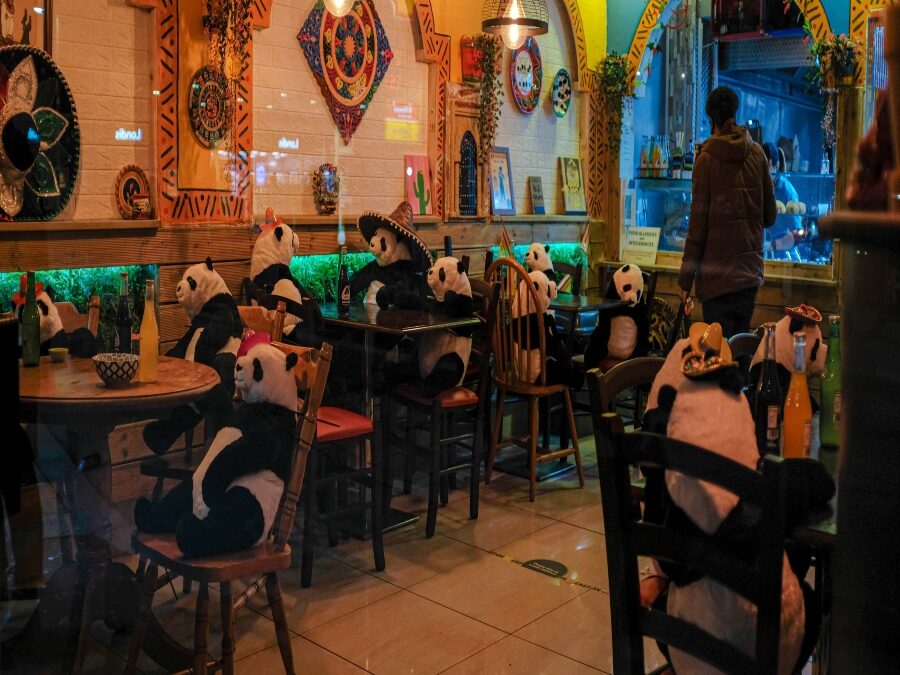
Step into the Mexican restaurant together, you beautiful protagonists. Shake the drops off your umbrellas.
Wouldn’t’ve guessed it from the Spanish-mission-style façade, but it’s a sprawling interior.
Though it looks like you’re the only patrons there tonight.
The white lights are hospital-bright.
There’s no mariachi music. No burble of conversation. No crunching of tortilla chips.
Just the weather outside.
A lank older woman with a chic black pixie cut asks if you two cutie pies have a seating preference?
Look at each other, at the expanse of empty tables, at each other again. Shrug.
Secretly, sure, you’d both prefer a booth. Cozy, private, off to the side. But you don’t want to assert such a trivial preference on a first date.
No, show that you’re low maintenance. Like it says in your dating profiles. You’ll take whatever.
She has a very special table for Mr. and Mrs. Follow her.
Ha, no, not Mrs., just Ms., you’ve really only just met and—
¡Ay, qué lindo! Young love. She was in love once, too.
Well, um, you’re not in love, ha, you just met on the apps, but—
Oh? Lust, then? Dios mio.
She makes the sign of the cross and seats you at a four-top high-top in the middle of the dining room, smack dab. Here are your menus—bam, bam—Rico’s your waiter, he’ll be with you shortly. Cuties.
She winks, walks back to the host stand.
Your table is directly beneath a papier-mâché catfish, dachshund-sized, with googly eyes and a wispy Fu Manchu that appears to be made of real hair? The thing is suspended by nylon fishing line looped over a ceiling hook.
Don’t say you hate it. Be positive. Smile at each other. Pick up the menus. Hear nothing but the muffled storm.
Would you like tequila?
Who said that?
Look around. Look up.
It’s the ugly catfish.
He seems bigger somehow. Not dachshund but maybe dalmatian-sized now?
His piscine countenance nevertheless betrays his impatience.
Would you like tequila please?
Look at each other. Hope the other will answer first.
Um, sure? Yeah. What does Rico recommend?
Rico recommends the Clase Azul Reposado.
Uh, that sounds good to you, you guess, right? Right. Not that either of you knows shit about tequila. You’ll take two shots of that, please.
Rico thanks you, closes his googly eyes and continues to hang overhead.
Look at each other. Wonder how this works. Like, is Rico going to go and get you the shots somehow or…?
A flash outside and then thunder.
And then, here inside, there’s a sound like something stretching. It seems to be coming from above. Look up. Rico seems to have ballooned to the size of a Rottweiler.
Look over at the host stand. Your hostess is just smiling out at the glass entrance doors, spackled and blurred with droplets.
The ceiling is starting to crack where the hook is anchored.
Scoot your chairs back a bit. You can guess what’s coming.
Boom!
Rico, now the size of a mastiff, has fallen onto your table in a shower of plaster.
You’ve inhaled some dust, gotten some in your eyes.
Cough it out, wave it away, wipe your eyes.
Rico is moaning as he flops and thrashes on the table. His wispy ‘stache is filled with bits of rubble and dust.
¡Ay, pinche…!
Wonder if he’s real enough to ask him if he’s okay, is there anything you two can do to help?
He continues to flop, to gasp, to swear in Spanish.
Look to the oblivious hostess again. Try to flag her down.
No luck.
Get up off your asses, walk over there, tap her on the shoulder.
Yes? Can she help you?
Hi, yes, um, Rico—
She looks over at where she’d seated you two cutie pies. Rico has flopped himself onto the floor now.
Ay, pinche pez.
For a moment, she closes her eyes, bites her lips. Then she crosses herself, opens her eyes.
There’s a tall stack of plastic red buckets by the host stand. She grabs the top two and hands one to each of you. Here, hold these, please. She pulls out a box of latex gloves, tugs one over each of her hands with a stretch and a rubbery slap. She takes a deep breath, grabs a colorful stick that’s leaning against the wall, and leads you back to your table.
The three of you stand around poor Rico as he coughs and struggles on the tile.
The hostess makes the sign of the cross again, raises the stick over her head, and then begins to smash it down on Rico’s bloated belly.
¡Deténgase, por favor!
But she continues. Bam, bam, bam.
¡No, señora, por favor!
She continues until the light goes out from Rico’s googly eyes and his side splits open and it’s quiet and still again, except for the storm outside.
Look on, both of you, in complicit horror as the deed is done. Look on at what you didn’t prevent. Look on at what—it could be argued—you have caused. Realize how tightly you’re holding the handles of your buckets.
The hostess kneels down on the hard floor, grabs each side of the gash in Rico’s flank.
Watch the muscles on her thin arms tense and contract beneath her loose skin as she tears Rico in two with a loud r-r-r-r-rip. Watch a hundred tiny paper fishes spill from his belly onto the floor and begin to flop around. It sounds a little like the rain.
And aren’t you supposed to be the protagonists? Aren’t you supposed to be driving the story instead of watching it? Why are you just standing there, holding those buckets as the hostess scoops up and dumps squirming handfuls of paper into them? Can your consciences hide behind the anonymity of plurality?
The hostess grumbles as her latex hands corral and capture the slippery paper fish.
Ay, so many. Go get her another couple of buckets, cuties. You saw where they’re stacked, yes?

by Fractured Lit | Nov 1, 2023 | interview
- Hi Ra’Niqua. It’s a time for you. Your first collection, flash fiction, For What Ails You, comes out from ELJ Press on November 6, and not too much after, there’s the matter of the twins you are carrying coming out. Congratulations on all of it. Besides being exhausted, how are you feeling? Share some emotions. Brag!
I am in a really complex transitional phase right now. I’m transitioning into being a mother of two, having my first book out, and finally finishing school. In May, I graduated with a Ph.D. in English, specifically African American literature, with a focus on Black queer feminist studies. This has so far been the best and most exciting time of my life. Does that count as bragging?
For What Ails You started out as a chapbook—I made the goal in late 2021 to get a short collection published. I came up with ten flash ideas and drafted them within a few months. When Ariana at ELJ Editions wrote back to accept the chapbook, I was asked to expand it into a full collection. I happily agreed with the caveat that I wanted to experiment with genre. I had no idea what would come from it. It took me three to four months to write the remainder of the collection, and I sat on it for several more months, submitting individual pieces here and there. The most beautiful thing to me about the collection is that it is representative of a time in my life when I had the freedom to spend as much time as I needed pounding out stories that came to me when life felt a bit more still. Hoping for more of that time in the future.
- Let’s talk about the collection. ELJ describes it as being about Black femmes who “battle a multiverse of woes, racism, and generational trauma.” Can you tell us what that looks like in your writing?
I came up with that tagline after I had drafted most of the collection. It was a way for me to reconcile my vision with the thirty or so somewhat disparate stories. Unfortunately, “multiverse” was and remained mostly aspirational. When I say multiverse, I’m thinking of Marvel or DC. Time travel. Doctor Who. I had a time trying to connect that concept to the grounded way I tend to tell stories. There are characters in the book who reappear, under different names, under different circumstances. So perhaps the book itself is the multiverse?
The racism and generational trauma hopefully make perfect sense by the end of the collection. For What Ails You mostly focuses on intercommunal concerns—family and friendships, and friendships that are or become family. I tried to show that even inside communities that folks might stereotype as homogenous, there are differences and cleavages—age, gender, class, geography, aspirations, etc. “What Comes Out in the Wash” has the main character address her own internalized racism at the death of her father. Two of my favorite pieces, “Glitters is Gold” and “From the Olive Tree,” depict families who come together, each member with their own successes, failures, prejudices, and so on.
- On your website, you self-identify as a “hood feminist.” What does that mean to you? How does it inform your stories and characters?
First, shout out to Mikka Kendall for writing the book that introduced me to the phrase. Hood feminism is very aligned with Black feminism, in that it attempts to center the needs of the most marginalized folks in our communities. For those of us who want to make the world better, we look to the people with the least, both in our communities and globally, to show us how.
“Hood,” shortened from neighborhood, adjacent to the word ghetto. It’s a word that has meant a lot of things. It has class connotations, and specifically in the US, it has racial connotations as well. Some folks use it as a dehumanizing term. I’ve told people I’m from the hood and have been subsequently asked if I support murderers and thieves. Stereotypes. As if there aren’t thieves and murderers everywhere.
For What Ails You is my attempt to celebrate hood folks. Some of the most creative people I’ve ever met have come from some of the worst neighborhoods. I was born in Atlanta in the early nineties. The city was very different back then. I saw things before the age of six that no child should, but there was also beauty there. And as far as I’m concerned, the beauty still remains.
It’s one I’ve never forgotten. With a title like that, it sounds like an epic novel, yet it’s only 1100 words. In that short space, you manage to invoke the Middle Passage, Revolutionary and Civil wars, the brutality of slavery, witches, polytheism, and create complex characters all within the setting of one of our contemporary blood-soaked battle sites, the football field. How did you craft this story? How were you able to layer it so? Have you thought about expanding it into a novel?
That story wouldn’t exist without my writing group, all GSU creative writing grads. We put together a few flash fiction workshops, and “Saviors, Spells, and American Tragedies” was a response to a fan fiction prompt. I settled on a character and a setting, and the tone/voice just came to me. Sometimes it happens like that—most times not. I got lucky that people vibed with it as much as I did. The inspiration for the story was to have fun and speak back to an author who had created a whole world with only the parts of history that were convenient. I just wanted to widen the lens a bit. The layering I might attribute to my academic interests. The classes I took on post-colonialism and global blackness have actually helped a lot with my fiction.
- Lightning Round 1: Who are your literary inspirations, present and past?
Toni Morrison, first and foremost. She was a force, and in my eyes, she was the best US writer we’ve had. A close second is Zora Neale Hurston; she was a writer and an ethnographer. Her writing cherished common forms of blackness in a way that was disregarded during her life. She didn’t really get the recognition she deserved until Alice Walker rediscovered Their Eyes Were Watching God decades later. Despite that, Hurston continued to chase the stories she loved, and there is a lot of information we might not have access to today if she had just done what was popular and celebrated.
In the present, I love my southern Black writers. The known folks like Jesmyn Ward and the folks who are becoming known like Exodus Brownlow and Hugh Hunter. They inspire me to keep telling the stories that matter to me.
- Lightning Round 2: What books do you want your twins to read? First as children, then as young adults.
One of the first books, the twins have received is A is for Activist. It’s so cute, but it highlights a lot of “big” political words that many people are afraid to say. Whether my love bugs agree or disagree with my outlook on life as they grow, I never want them to be afraid to talk about it.
I have a big collection of books—although my collection is smaller than it used to be; moving around a lot with books is too much. I’d love for them to grow up going through my bookshelves the same way I went through my mother’s shelves when I was a younger. I had to hide while reading her books, but I’ve got a lot less erotica than she did. She still doesn’t know that one of the first books of hers I read was The Coldest Winter Ever by Sistah Souljah. Not for kids.
- A second story I want to discuss is one you sent to our press (Roi Fainéant), “Exchange Rates for City Babies and Border Girls.” You open that story with the brilliant line: “Spring break meant a trip south of Atlanta to Georgia’s fat bottom.” I love this personification of Georgia. Give us the genesis of this line. I know your writing is deeply embedded in the South, and readers will need to read your collection, but can you give us some sense of your feelings toward Georgia and the South as a whole?
Based on the geographical borders of the state, Georgia has a fat ass. The top looks something like a military haircut. Then it balloons out toward the Florida border. That line was inspired by the time when my grandfather and step-grandmother moved to Thomaston. It’s a tiny rural town, which is honestly not that close to Florida, but that’s the fun of writing fiction. In my stories, I twist, cut, and break Georgia into shapes that work for me. In general, I became interested in writing about the South when I realized I didn’t have to let other people’s perceptions shape my own. I realized that the South I wrote, my South, didn’t have to be representative of anything but my own experiences. The catalyst for this realization was Ciara’s music video for “Oh.” That was 2004. The lyrics:
“This is where they stay crunk, throw it up
Dubs on the Cadillac, White tees, Nikes
Gangstas don’t know how to act
Adamsville, Bankhead, College Park, Carver Homes
Hummers floatin’ on chrome, chokin’ on that home-grown”
It was a version of the South I could recognize. I hope this collection makes Atlanta folks feel the way this song made me feel.
- As a Black feminist, intellectual, and writer, what do you make of these times? An amazing Black female writer, Deesha Philyaw, just got a seven-figure book deal, yet at the same time, books are being burned, and the Florida curriculum calls for discussing the positive skill-building aspects of slavery. Two steps forward, one step back, or the reverse? Who gets to tell the American story, if it even exists?
I like that the question of the American story ends with that caveat, “if it even exists.” There are millions of American stories. They all get told if you listen. My thoughts on this are probably controversial. I love to see folks succeed, especially Black femmes. I’m here for it all! However, individual victories are never going to undo the structural conditions that allow someone like Desantis to become governor and enact the full range of his bigotry. Florida doesn’t happen in cultural and political isolation, but often our victories do.
- What’s the hardest part of writing a short story for you?
The hardest part is following the story-telling rules. Making sure it has a plot with compelling beats, making sure the main character has an arc. As much as I love breaking rules, some of them really do make a difference. Even in flash fiction, there has got to be a beginning, middle, and end. I try my best to stretch what that means, though. In “Navigation for Mythical Beings,” a character rolls up on a mermaid in the middle of the night and drives off with her. The beginning is the character spotting the mermaid. The middle is the character contemplating what to do. The end is them driving off together. That’s not so much of a story arc, but for the life of me, that seems to be the only movement the story would allow. And I love it!
- Any advice for younger writers?
My advice for younger writers is to write what you see and what you want to see. My favorite part of teaching workshops, and especially workshops geared toward younger folks, is getting to see the students’ perspectives. They’re so creative and so aware. Step into the classroom with middle schoolers. They have stories to TELL, and I live for it.
- Any future projects you’d care to share with us?
I hope to make strides to get my novel published. The book, Frenzied, Desperate Birds, was my master’s thesis. It has been revised/rewritten too many times. The first few pages won third prize in the Craft Literary first chapter’s contest last year. I’ve submitted it to a couple of presses, but I plan to seek representation for it next year. I’m hoping I can place it because I feel trapped in a way. Like this baby has to go out before I can focus on writing another book. Wish me luck.
- Anything else I should have asked you?
What are your hopes for the life of the book?
I just hope someone reads it and loves it. I read it, and I love it, so my hopes have been fulfilled! Honestly, I don’t like to think about the reach of my work. It gets in the way of me being happy with what I’ve accomplished, and this book feels like a triumph for me. It was a dream in my heart, and I made it a reality. That’s the best thing.
****
Ra’Niqua Lee writes to share her particular visions of love and the South. She earned an MFA in fiction from Georgia State University in 2018, and she is currently at Emory pursuing a Ph.D. in early African American literature with a focus on spatial and Black queer feminist theories. She is the managing editor for Southern Spaces and Atlanta Studies and an assistant fiction editor for Split Lip Magazine. Her work has been anthologized in Best of the Net and Best Small Fictions 2023. You can find her at http://muddahlee.com.
Francois Bereaud is a husband, dad, full time math professor, mentor in the San Diego Congolese refugee community, and mediocre hockey player. His stories and essays have been published online and in print and have earned Pushcart and Best of the Net nominations. He serves as an editor at Roi Fainéant Press and Porcupine Literary. The Counter Pharma-Terrorist & The Rebound Queen is his published chapbook. In 2024, Cowboy Jamboree Press will publish his first full manuscript, San Diego Stories, which is the realization of a dream Links to his writing at francoisbereaud.com.

Recent Comments