
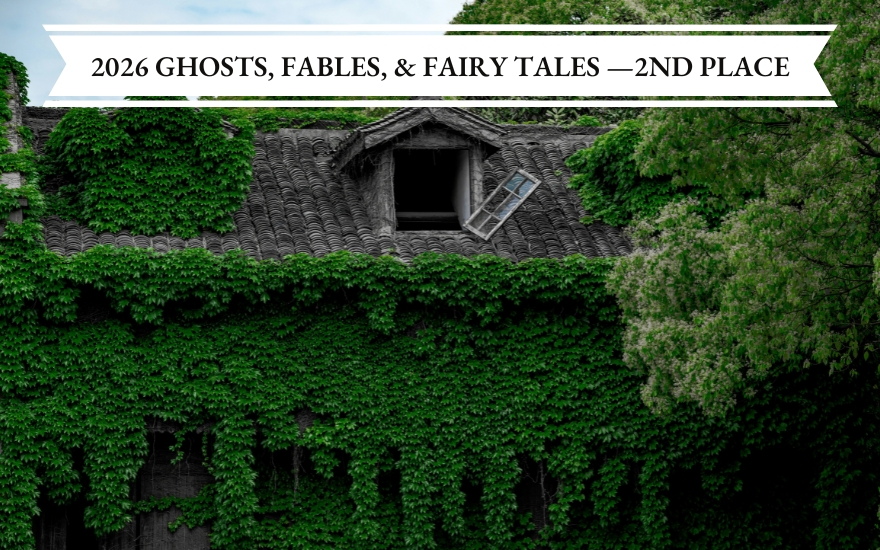
Dolly churns ewes’ milk until her palms blister red, fills her paper-lined pockets with soft and pliant butter, smuggles it out of the dairy before the rooster calls in dawn. Father doesn’t notice the loss. While he goes to market, she crawls through the knot at the back of the attic – a doorway hidden to all but her – and works.
Butter does for flesh, but not bone. For that, she cuts hardwood from fallen oak, takes Father’s knives to carve ulna and radius, tibia and femur, scoops out hip sockets with the hook-blade and slots the bones together at tallow-greased joints. She scavenges the rest: the spine of a stag found rotting under stooped willows; the finger-bones of a thief; her mother’s skull, plucked from the pyre in the grazing field after Father was sure there was no flesh left to burn.
The spell to wake her brother was her mother’s too, and the books that name the bones and biles and beasts and all the flowers that bloom under her window. They teach her which herbs heal, which hurt, which kill. They teach her how to darn socks and stitch her skin together with a neat seam. They teach her how to make little friends of her own – dancing teacups and wool-stuffed pillows sewn into winter night companions. All of this in the room Father cannot see.
On the day Dolly was born, her mother told her that a boy once played here in the attic. A boy with autumn curls and eyes like mossy pools. The room grew with him; they were twinned by his mother’s womb. Notches line the doorway like the stretch marks that banded her stomach. Thirteen notches, one for every year.
Dolly spends hours moulding the arched nose, pressing the philtrum into a swooping valley, only to return the next day to find the septum askew, lips slipped into a sneer. The left orbital cavity, hollow and waiting, becomes a malformed crescent under the drooping brow. It would be simpler to carve her brother wholly from wood, like the toy soldiers her mother enchanted to march back and forth on the windowsill. But the soldiers’ painted faces are distant, their eyes dull. Dolly likes to feel her brother’s flesh give way to hers.
Father cannot enter the attic room, but the rest of the house is his. After the day’s work is done, after supper and cider, he settles by the fire to whittle wide-eyed owls and ram’s heads with twisted horns. Dolly watches him peel back soft strips of birchwood and let them fall like cinders.
He doesn’t see her. This, she understands, is another of her mother’s gifts – one last spell to cloud the eyes of wolves, to make Father’s gaze drift over her like river over rock. She lingers until the fire gets low, until he stoops to nudge the embers with his knife. Firelight catches the wet of his eyes. Dolly returns to the attic.
To stop the face slipping, she carves moulds, packs the butter tight. She can’t be sure that her brother’s features will set in shape once the spell is complete, whether he will always need a little touch here and there to heal the wilting. It doesn’t matter all that much. They will learn to fix each other.
Dolly lays the parts of her brother’s body on a patchwork blanket. She knots hands to arms, feet to legs, head to neck; slicks the seams shut with the back of a sun-warmed spoon. Between each stage, she douses her hands in cool well-water so as not to smudge the flesh. When she pulls the wooden cast from his face, it leaves grooved veins in his cream skin.
He’s beautiful. Handsome. Made perfect by his imperfections – stray thumbprints and nail nicks. Signs of love.
Except the eyes. She fills the dead pits with acorns and dandelions and wild strawberries and the smoothest skimming stones she can find. Her brother lies inert.
Outside, pebbles skitter under wooden wheels. Father returns. He unloads the cart, heaving milk-pails and bundles of black wool into the cellar. Sweat pools across the yoke of his shirt, and he rests on the stone wall to catch his breath, squints against the late spring sun.
It’s near dusk by the time he staggers inside. Supper waits in the kitchen, a mug of cider next to his plate. Dolly watches him falter, his spell-fogged mind struggling to question the gift. He eats, he drinks, he carries himself to the living room, slumps in his chair. The fire is already lit. His hand reaches for the hook-blade in the basket; fingers, tingling into numbness, grasp nothing.
Dolly stands before the fire. She’s lithe as shadow, slippery as guts. His gaze slithers over the black woollen curls sewn into her white scalp, her ears cut from ram’s horn, eyes like mossy pools. A circlet of stitching around her wrist aches as she grips the knife. She pinches his eyelashes, pulls the lid back. His eye rolls in its pit, and it’s nothing, really, to curve the blade behind it. Like carving the belly of a spoon.