
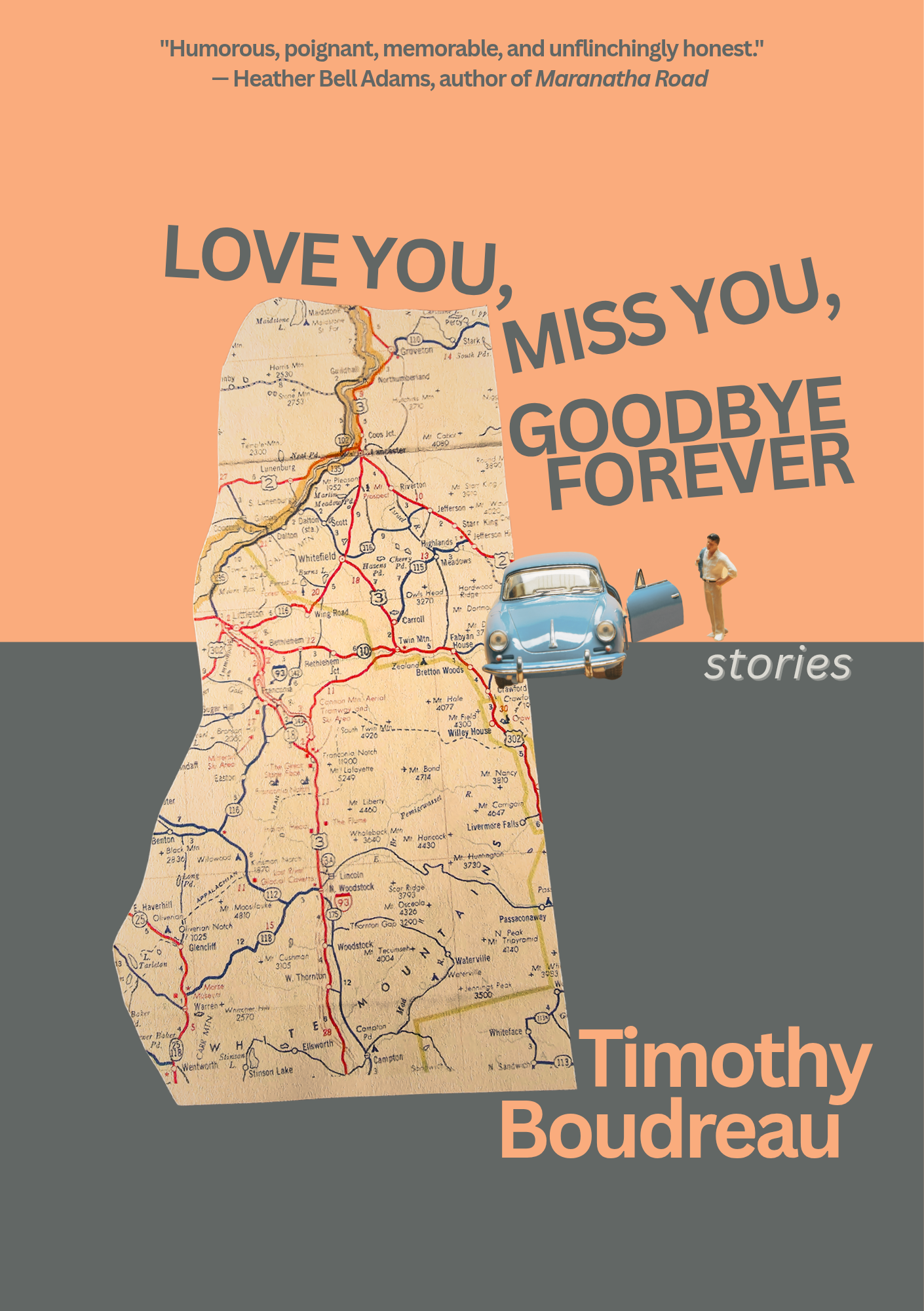
Timothy Boudreau’s Love You, Miss You, Goodbye Forever is coming in March from Stanchion Books. Get your copy HERE or wherever you buy books. Guest interviewer Patricia Q. Bidar recently met with Timothy to discuss the collection, Boudreau’s second.
Patricia Q. Bidar: I think of you as a writer of realistic, intense fiction. Reading your book, I was struck by notes of surreality, climate change dystopia, hyperrealism, crime, and even body horror. Do you think of your writing as free from traditional modes? Was the unconventional there all along?
Timothy Boudreau: Realistic, intense fiction is a reasonable description of what I usually aim for, but sometimes I like to follow different paths. For me, flash fiction is freedom; it encourages us to play, to make something short, strange, and intense, and not worry if we can (or want to) maintain the strangeness for a longer piece.
PQB: Repeated themes include nature, illness, family ties, and aging. One theme that cuts deep is the inability of parents to understand their children. In other stories, a deep connection between siblings or co-workers provides acceptance and understanding. Can you say a little about that?
TB: It may be more accurate to call it the inability of parents and children to understand each other. The sibling connection is a powerful one. These are typically the longest relationships in our lives. Being the eldest sibling, I’ve sometimes yearned for an older sibling to take me under their wing. Not that I necessarily did that for my real-life younger siblings! Coworkers can become another kind of family. We sometimes meet people there who remain part of our lives until the end.
PQB: Setting plays a major role here. A small hometown or workplace can cradle and nurture. In a darker translation, venturing out of the known place is frightening or unthinkable. Is your use of setting inspired by writers who influenced you?
TB: Writers I read as a teenager influenced my use of setting: William Faulkner and Flannery O’Connor. Ernest Hebert, a New Hampshire writer whose brilliant The Dogs of March we read in high school. Later, reading James Joyce’s Dubliners was an aha moment. Joyce’s struggling, poor Irish characters reminded me of people around me in northern New Hampshire. Any setting can be universal.
PQB: Your work presents sexuality in a candid, unsentimental way. Bodies young and old are skinny, pale, furtive, failing, or “like [they’re] made of poison ivy.” Similarly, your characters are often being overtaken by the natural world or illness. Has this impulse long been part of your writing?
TB: The impulse becomes stronger the older I get. I enjoy writing about eccentric, imperfect, but enjoyable sexual relationships between older characters. These are so often played for laughs in mainstream media (“Ugh, Grandma likes to have sex, how disgusting!”), so it’s a pleasure offering a different perspective. Several of the more sexual stories were born in Monet Patrice Thomas’s writing challenges, which encouraged me to approach sexual themes from different angles.
PQB: Some of the book is darkly funny. Thinking of The Oral, Listen Peepaw, and Life is Too Short for This Level of IDGAF. And the studly, good-natured worker who arrives to repair a roof during a cataclysmic weather event. How important is humor to your writing?
TB: Humor has always been important. I can’t think of a better way to express certain truths about life. I appreciate people who maintain their sense of humor in the most trying of circumstances. People who slice straight to the bone to express the essence (often absurd, painful, and hilarious) of things.
PQB: As the title suggests, the book is broken into three sections. How did you approach sequencing for this book? Did your publisher, Stanchion Books, get involved? Going further, a shadow meaning could be, “Love You, Miss You, Goodbye Forever” to this life, to strong bodies, to our natural world. Did these themes come to you as you were assembling the stories?
TB: The arrangement is mine, and I hope it gives the collection momentum and cohesion. Jeff Bogle’s design beautifully helps bring the title concept to life.
While rejecting my then-current manuscript, one publisher suggested I keep only the “shorter, weirder” pieces. Love You… is the result. The longer, more traditional stories became Stepdad on the Dance Floor, due from Unsolicited Press in August 2026.
The section titles and themes came together relatively quickly, though a few stories might’ve fitted into more than one section. It was important for me to try to make a unified statement.
PQB: Busy writers want to know: you have a job, close ties with family, and live in a “high maintenance” weather region. This is your second full-length book, and you have two others slated for publication before the end of 2027. What can you say about writing as a vocation and finding a way to do the work?
TB: The publication timing is misleading. Along with the several years covered by the Love You… stories, the stories in my Unsolicited Press collection cover a period of nearly thirty years. And it took many years to finish my upcoming novel. It only looks like I’m churning books out one after another!
That said, writing is always a priority. I’m a morning person, and work best early. But my method involves maximizing the bits of time that come my way. And to make time when I can. It won’t get done unless I do it!
PQB: At what age did you start writing seriously? When did you begin writing flash fiction? How did you begin sending your work out to journals and presses?
TB: My interest in flash fiction emerged from participation in the first of Monet Thomas’s challenges, followed by a workshop with Kathy Fish, both in 2018. More than anything, the discovery of the flash community was a revelation!
I was fourteen when I started writing for my own pleasure and purposes. I was twenty when I submitted my first story to Yankee Magazine. Handwritten at the bottom of Yankee’s rejection was a note from editor Edie Clark: “Your writing shows real promise.” It’s a blue ballpoint message I held onto for decades, through rejections, isolation, and depression, hoping it was true.
***
Patricia Quintana Bidar is a western writer from the Port of Los Angeles area, with ancestral roots in San Francisco, southern Arizona, Santa Fe, and the Great Salt Lake. Her work has been celebrated in Wigleaf’s Top 50 and widely anthologized, including in Flash Fiction America (Norton), Best Microfiction 2023, and Best Small Fictions 2023 and 2024. Patricia’s novelette, Wild Plums,” is available from ELJ Editions; “Pardon Me for Moonwalking”(Unsolicited Press) is available now. Patricia lives with her husband, Trinidad, and their unusual dog outside Oakland, California. Visit patriciaqbidar.com or @patriciaqbidar.bsky.social.
Timothy Boudreau lives in northern New Hampshire with his wife, Judy. His collections “Love You, Miss You, Goodbye Forever” (Stanchion Books) and “Stepdad on the Dance Floor” (Unsolicited Press) are forthcoming in 2026; his novel “All We Knew Were Our Hearts” (Unsolicited Press) is due in 2027. Timothy serves as an editor at The Loveliest Review. Find him on BlueSky at @tcboudreau or at timothyboudreau.com.