
by Dani Blackman | Jan 26, 2023 | flash fiction
there is no romantic connecticut the text says, but I don’t take this as rejection. I don’t blame autocorrect. I read her words again, but can only see Connecticut, cut with all beauty this time of year —clean snow over old hedges and children sliding streets in stiff jackets—how could it not be a contender? This must be how loneliness and yearning fell us, because in an instant we have a future, one that takes us to a winter under the covers, whispering romantic connecticut after exhausting all good language, spending our mouths on the thickest parts of our bodies. I want you to see it too—
my teeth taking her thighs until you’re pulled so close that I can only hum into your skin.
no, there is no romantic connection she writes, but that isn’t accurate either, as if shovel didn’t meet dirt to tend, as if she hadn’t spent her whole life planting one pretty word against the next. She can say I’m empty of what she desires, though what to desire? We don’t know.
Here the mountains sit as the hunched backs of women, still in the grey, storing light beneath their hard peaks. It goes this way, our confusion and complexity, so I keep no romantic connection as truth. She offers friendship. I thank her for honesty.
What I want to text her now, without exclamation points, is this: I’ve shared soft beds with women whose names I can’t remember. Some I only knew for hours before I gave: here –- here –- here –-
In the lightest part of a day, a girl dared me to look right in her eyes
and say something hot about her tits. Now I speak. And I speak. And
maybe every fifth one hears something unforgettable. Maybe I’ll
congratulate myself for urging women to such greatness, spooning a
food they’ve been told to taste, moving for the ones who learned for
men, and such construction should come with consolation. The best of
the exes didn’t believe in marriage, or longing, even when she felt it
build inside her. She ducked her head whenever I pointed a camera her
way, so I don’t have much in terms of reliving our time, but how do we
remember love now if it’s not recorded, then
rewound?
My mother never cried. But on long road trips, with me and my sister strapped into the back seat, she sang Linda Rondstadt’s “Love Has No Pride” with such conviction that I thought she might drive off the road. And she did sometimes swerve for dramatic effect. She sang with her hands off the wheel and implored me and my sister to listen, really listen, so that what survived from these coded life lessons is this: feel pain and pleasure equally, let experience top vulnerability, give and feel, give and feel, then pay for it later.
In Northampton, MA, lesbian capitol of the world, a lover said I might be the most passionate person they’d ever met, but we’d never be in love. I, too, sing out and raise my arms to the air. I can’t carry a tune, but passion can make a mother proud. I think of Mom now, how quickly married men snuck out of her bedroom on school mornings, how she worked my father into one last time, how her loves came so relentlessly and intermittently that I never learned to land between starvation and saturation. I think of how she stocked full this inheritance, what we transfer from one woman to the next, how
I once kissed/with uncertainty
my mouth tightened/hands
slid from the waist/loose
despite what I offered/I knew
if I stopped/ I’d have to see
in her/myself
searching
Tell me, then, how to watch fears take truth, how a teenager’s missteps return to beat fruition, how to just go and go, because that’s always been better than standing still.
I said, “You’re really beautiful.”
She said, “You’re really not that short.”
What I believe, still, is everything I give is the beginning of what I can do, that I can stand in the desired without having to call up the ones I’ve loved to listen to them say
you are good
20 years and one day, I’ll feel enough like a champion to stop counting. But now I still need one lover + the next + that naked blonde on her birthday + the way my girlfriend slept with fists on my back so I would always feel her weight + the weight + one who said I turned her straight + the fling who came back 4 years later + the best friend +
Simple math: time has never given one more minute, time has me now tired
But I go and go, with hope, with shame, with collections that stay like trinkets shoved in the bottom of a suitcase, carrying what has always remained
her possibility
and mine

by Jasmine Sawers | Jan 24, 2023 | contest winner, flash fiction
After you left, a goat took up residence in the left ventricle of my heart.
I didn’t know about my little stowaway at first. I thought I simply wished to say “no” more often and while screaming. I thought the quality of my enunciation had merely slipped the same way my housekeeping had. I thought I was finally becoming the curmudgeonly old man I had dreamt of being since I was a little girl. Freedom, I thought, is no pants and a tin can to chew on.
I lost feeling in my extremities. Brown fingertips and little mushroom toes went pale purple, lavender maybe—quite nice a color if I were a flower, which I’m not. On a good day, I am a person.
“We care about you,” some of my friends said.
“We know this is hard,” said others.
“You need to get this shit looked at it,” said the best ones. “It ain’t right.” That’s how I ended up on my back in an MRI machine, which is a tube that contains more than its fair share of dread.
“Aw,” the doctor said. “There he is.”
“What?” I said. “Abort it!”
“It’s not a baby,” said a friend. “Oh my God. Look at it. It’s so cute.”
“It’s a tiny little goat,” said the doctor. “Right in your heart. That’s the organ that pumps blood through your body.”
“I know what a heart is,” I said. “Why is there a goat in it?”
“Same as any parasite,” the doctor said. “Not exactly run of the mill, but this sort of thing is not actually that uncommon. A simple surgical procedure, and you’ll be good as new.”
I was rolled out of the MRI machine and shown a picture of my goat. He’d taken a great big shit right in my inferior vena cava. He was chewing on some grass. He was wall-eyed and smiling.
“What happens when you take him out?” I asked.
“You get a sticker and go home,” said the doctor. “That’s where you live.”
“No, I mean, what happens to him? Do you give him to a petting zoo or something?”
“Oh my, no,” said the doctor. “He’ll die instantly. That means right away.”
“What happens if I don’t get rid of him, then?”
“You’ll die gradually,” the doctor said.
“That means real slow,” my friend said.
“You’ll stop being able to see colors,” the doctor said. “Food won’t taste like anything. You’ll be tired all the time on account of his blocking up your blood flow. And in the end, you’ll just fade away.”
“And the goat?”
“He’ll burst out of your ribcage and terrorize the town in a fit of bloodlust.”
“Just schedule the surgery,” my friend said. “Everything will look better without a goat in your heart.”
But I went home that night, and I took a piss on my grandma’s antique davenport. I took off all my clothes and wandered out into the yard. I left the door open. I followed the scent of sweet clover.
Originally published in The Conium Review.
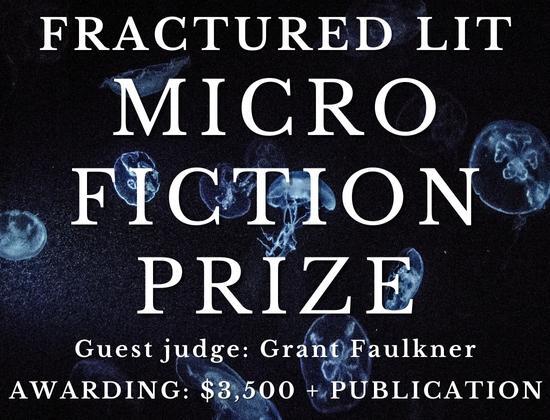
by Fractured Lit | Jan 20, 2023 | micro, news
- Raising Rabbits
- Will These Elevator Doors Never Open
- Hope
- Aquatic Mammal
- Anchorite
- A Strange, Silent Relief
- My husband said, keep baking bread
- Self-Solemnization
- Burn It All Down
- Casual Pinch, 1992
- Monday
- Bath
- Cuckoo
- Drapes
- Coexistence
- A Lovely Light
- Pelican
- Hold Fast
- Relict Communities
- What It’s Like
- Minnow
- Mirror in the Ghost

by Tochukwu Okafor | Jan 19, 2023 | contest winner, flash fiction
Boy, on the night your mother brought you into this noisy, miserable world, at exactly 11:18 pm, on a rainy Thursday, your father reclined in his Toyota car outside the Emergency Unit and sucked on the titties of a nurse, the same nurse with the pointy bra and four-inch heels who was your mother’s best friend at the clinic during her antenatal classes and always told your mother oh how it was not a stroke of luck that brought the two of them together but a thing our gracious God had arranged—as though she’d spoken with our gracious God in her tiny, musty office lined with shelved paper files that dated as far back as 1978—which was a big fat lie, as your mother’s elder brother worked in the United States Embassy, and the poor sneaky nurse thought that if only she would help your mother jump queues at the clinic your mother would someday return the favour by helping her obtain an American visa, and ahh dear Lord, how the sloe-eyed witch had partly succeeded: she nestled too cosily to your father, held the silly man’s stiffness in her small soft hands, cradling it, and listened to him moan ooh I like that; sweet heavens; go faster, baby; while your mother screamed and screamed, the entire theatre choked with doctors running in a great scatter down the length of the corridors, so that when your head poked out first, all gooey and matted with red, your mother bawled Jesus Jesus and nearly passed out, but a young female doctor stood behind her head, encouraging her—“It’s almost over,” she said, “Push,”—and then you were out, brownish, weighing a few pounds, and your mother muffled her tears, and your father came sprinting towards the ward, his fly wet and unzipped, but the chief operating doctor caught him midway, told him he was a proud father of a baby boy—oh, how your father’s eyes bulged in joy, how he danced in circles round the doctor—and he ran back the way he came, chanting, “Boy, boy,” he did not ask to see you or your mother, for on that same night, he drove to a strip club outside town and had a few bottles of beer—“A few bottles with my friends from the office,” he told your mother the following morning when he returned to the hospital—that left him wasted and drooling by the open gutters, a spectacle for early motorists and passersby, especially the school kids who stopped to ridicule him (all of which the security man at the gate told your mother, but she feigned deafness)—and as your father walked out of the ward, his trousers sagging round his waist, revealing mounds of black, private flesh, he commented on your beauty, boy, the way your eyes seemed half-closed and your jaws stretched taut for a day-old baby and your lips sported a sated smile and your skin that your mother swore she would not let know any brightening lotion, haha, how quickly she forgot that this noisy, miserable world treated beautiful boys differently, hahaha, how uncalculating of her to forget, too, that you would grow so swiftly, but we must tell the story about how she got fed up buying and changing your diapers so frequently, she thought she’d better save money by allowing you to strut around the house naked, pooing all over the place, and this was when she dragged a new house girl into this story—let’s call her Ruth—this girl, your father’s would-be secret girlfriend, who cleaned after your mess and learnt how to handle two jobs in a short space: housekeeping and clandestine late-night romping with the boss, ohh poor Ruth, she worked her way through your watery shit and dirty dishes and never ceased to complain to your father amid a hasty fuck that it was unfair he had refused to take her as his second wife, buhahaha, good gracious Lord, and with your father’s senseless craving for women, one might think you would trudge his path, but no, no, no, you were a church boy, an academic boy, a sports boy—no one could bother if you even cared about girls, in fact, your mother often chuckled to herself, “All these cheap girls will soon begin chasing my dear son. Look how much success and respect he has brought to my family,”—hahaha, poor woman, she did not know that your eyes never strayed to those girls who cooed after you or those girls who forced their hands in yours and begged that you walked them home or those girls who slapped your hard bum when the teachers were not looking, alas, or no alas, as it was not a surprising thing at all, on the eve of your thirteenth year, your mother discovered your father’s affairs with Ruth, an uneventful discovery, as she had returned with you from the market and had found the both of them sweating, clinging to each other, naked, and she had said to you, “Boy, close your eyes,” and she had screamed and fought and wept, and right on your thirteenth birthday, before the clock struck 9 pm, your mother announced that she wanted a divorce, which marked the beginning of the silent cold war in the house, and because you had no one to talk to, it was inevitable that you would spend time with Jude, the shy, brilliant boy who lived on your street and attended your school and miraculously became talkative whenever you visited him, which you liked so much because on your fifteenth birthday, when you told him your parents were no longer separating, Jude the shy, brilliant boy flung himself at you and kissed you and you kissed him back, and in that moment you knew what kind of love would work for you in this noisy, miserable world.
Originally published in SmokeLong Quarterly
by Davon Loeb | Jan 17, 2023 | contest winner, flash fiction
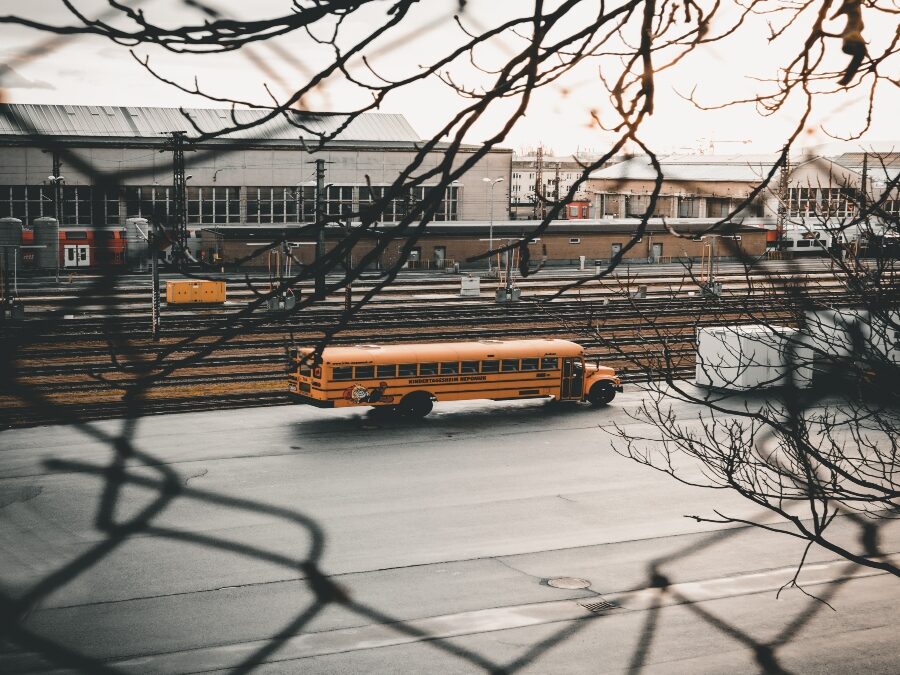
On the school bus you should have seen them, monkeying around about wheels, bottles of non-alcoholic beers, Rock-Paper-Scissor, two kids having a shootout with six-piece revolvers, percussive wet claps from fingers squished between armpits, cheers, and are-we-there-yets. It really takes a special kind of person with the patience of a rock to be here, to wait, to listen, to be responsible for this kind of madness. And that’s just what the teacher and chaperone Mr. Tucker was doing, clutching his clipboard, the cork-color of the board blending with the brown hue of his hands. He called out names, checked them alphabetically. He breathed full, as if saying some mantra in his head, his heavy chest rising, like a mountain, in and out again. For a bus full of sixth graders is a visceral thing that gets in your skin, and even Mr. Tucker knew he couldn’t wash it out.
But if you don’t remember what it was like, these moments on a school bus, try to use your senses, try to remember how the unguarded sweat smells like a mildew or the ever-present release of gas, some silent and some just deadly. Recite the sounds of an orchestra of do re mi belches. Hear the language, to not only describe childhood, but to decipher it: spaz, dork, dweeb, loser, nerd—the tongues after Babel. And if you remember that, reach your hand under a seat and touch the collection of gum wads. Remember the pang of being struck in the head by a swinging seat belt buckle. Listen close to those kids who always sat in the back, how much fun they seemed to be having, how they jammed four-packed in three-seaters. Visualize the faces they made at passing drivers—how long their tongues could snake, how far back their eyes could roll, how their naked skin pressed like a squeegee to the glass.
As if a wave of fans at a stadium, a series of –ohs followed when one kid, the biggest kid, flipped his middle finger at someone driving behind them. And this kid was the one who hurt people; the same kid who pinched and bit other kids in elementary school, and how now he was notorious for squeezing arms and twisting them until the skin ached and reddened, and also known because his clothes smelled, and his parents were always late to pick-up; but if you told him that, he’d use his pubescent body to bruise you. Sure, he was bigger than most; and yet, in his own way, he was the smallest. That’s what you have to remember, if anything. He punched the kid next to him after he saw the driver in the car behind them yell something and speed up: then he told the kid not to say nothing.
The driver waved them down, Mr. Tucker braced for the sudden stop, and then the driver was hammering on the bus door. Mr. Tucker stood, a tall figure that almost touched the exit hatch, and from the tight three-button school-issued polo, the veins in his neck bulged, the frustration coursing through his body, and he turned and faced the children. How all the muscles in his torso tensed, how they could see each striation clearly, how they knew he was changing into something, how they swore he was a monster, and he climbed from seat to seat, gripping that upholstery, leaving the outline of his angry fingers—fingers searching for the culprit. From his belly, a deep growl like thunder, “Who did it,” and it wasn’t a question. The kids in the front pointed to the back. The kids in the middle pointed to the back. The kids in the back knew Mr. Tucker was there before he arrived; they felt the thud of his boots; they sensed the inhalations of a beast, they smelled the coffee on his breath, and it was on top of them. Most of the kids in the back kept their heads down, and one, still rubbing his arm and wincing, pointed to the kid next to him.
***
The biggest kid with the middle finger was moved to the front of the bus next to Mr. Tucker. The rest of the drive to the field trip, no one said anything loud enough to be heard outside their three-person seaters. All the other kids who were alone in two-seaters, didn’t feel all too bad for him, the boy next to Mr. Tucker. Some of those kids’ arms were still red and on fire. They smiled, and since they sat alone, no one noticed. When they arrived at the Constitution Center, the entire day, Mr. Tucker and the kid walked together. Some said they saw Mr. Tucker and him eat lunch together, that Mr. Tucker split his sandwich and gave the kid the other half, and that they talked a while on a bench separate from the group. They say they saw Mr. Tucker laugh, an octave of his voice they never heard before, high and like a hyena, and how he slapped his knee so hard it sounded like he broke it. The kid next to him finally looked small, but also seemed desperate to stay in the moment; he stared at Mr. Tucker as if he had found something that he had lost long ago. He stared and held his eyes there because he knew it wouldn’t last.
When they arrived back at school after dark, the kid’s mother wasn’t there to pick him up. Mr. Tucker tried to call, but she didn’t answer. So they sat outside the school, their shadows eclipsing the floodlights, a larger body, a smaller body, and they played games of Rock-Paper Scissors.
Originally published in Pithead Chapel.

by John Haggerty | Jan 12, 2023 | flash fiction
Alison was a cheerleader, and the second-prettiest girl in our class. These qualities seemed extremely important to us at the time, at least until she accidentally killed one of the football players with her car.
It was a BMW, a red convertible. Her father, who did something mysterious but clearly important, had given it to her on her sixteenth birthday, one of the many gifts given to her throughout her life.
She had also been given glossy, shampoo-commercial chestnut hair, and resplendent sugar-white teeth. She had been given trim buttocks, and the type of breasts for which the cheerleader sweater was designed. She had been given her parents’ divorce, which applied a thin but gratifying veneer of tragedy to her life. She had been given a mother who had the good taste to relocate three states away, sparing Alison the humiliation of seeing her debasing herself with men possessing only a fraction of her father’s net worth. She had been given a faux-Georgian mansion with many large, echoey rooms, and a bedroom filled with flouncy, cartoonish princess touches, like an overstuffed pink chaise that nobody ever lounged upon, and a luxuriant bed with enough layers of canopy to repel every anopheles mosquito and tsetse fly in the Congo, should they have ever been called upon for so prosaic a purpose. Which they were not. And before she killed him, she was briefly blessed with Anthony, who was about as mean a motherfucker as had ever attended our school.
Anthony was a towering, brooding boy from whom things had mostly been taken away: his father by the police when he was ten years old, his mother by social services two years later, his capacity for kindness and empathy by the world at large, whose main lesson to him was that things had to be taken or they would never be had at all.
We were perplexed by this unlikely pairing. The football player/cheerleader nexus was a well-trod path, of course, but Anthony wasn’t particularly handsome, or particularly talented, or particularly clever or amusing. Junior college washout was his ceiling, we all thought with some satisfaction as he was banging our anonymous heads against walls or kidney punching us in the hallway for no apparent reason.
Even now, years after high school, we still wonder at their relationship. Why, of all people, would a girl like Alison choose a boy like Anthony? Were they obeying some natural law, the attraction of opposite forces, the positive to the negative, the damned to the divine? Was she testing her admittedly fabulous luck, an adolescent Icarus winging her blithe way toward the event horizon of Anthony’s black hole? Or perhaps she simply made that most common mistake—mistaking ferocity for confidence, viciousness for strength?
But now, years removed from the events in question, we have begun to think—to hope, really—that in their brief time together, they found something more. Is it too outlandish to believe that Alison, so thoroughly blessed with an easy life, saw something that we could not, the boy behind the pain, the man that he might have, under different circumstances, become? Or that someone like Anthony, a boy who had been given nothing, might be the only one among us who could pierce the surface Alison, to find his way through all of the dazzling unearned gifts to the sad, lonely girl beneath?
In the end, we suppose that it doesn’t matter. The details of Anthony’s death, obscured by layers of lascivious speculation and rumor-mill enhancement, were never completely clear. Some of the common threads seemed plausible enough: the red convertible, a turn taken too fast, Anthony perhaps standing up on the passenger seat, overcome with the exhilaration of youth, the joy of his association with the second-prettiest girl in our class, with the never-experienced sensation of having at long last gotten a break, of feeling that his luck had finally and irretrievably changed.
And Alison was, in turn, given that last moment with him, hands still clenched on the steering wheel, feeling as though she might never be able to let it go. The convulsive lights of the emergency vehicles strobing off the dashboard of her expensive car. The moonlit sheen of blood on the road, so much blood, a covered corpse on a gurney being shoved into the back of an ambulance, a brief glimpse of the infinite present, the moment in which the Anthonys of the world both exist and do not, where she is simultaneously the luckiest, second-prettiest girl in the whole school and something else entirely.
Alison disappeared soon after that, hustled off to one of those private schools devoted to hiding the shames of the rich. We made our anonymous way through graduation and into the world, discovering, via a cadre of federal prosecutors, that Alison’s father’s job was perhaps much more illegal than it was important. We begin to forget Alison entirely, dredging her out only occasionally as a cautionary tale.
And then, years later, we see her again. She is a phlebotomist at our HMO, the technician who extracts blood for laboratory tests. We’re not sure it’s her at first. Her posture is stooped, her skin grainy and tinged with fluorescent-light gray. We glance at her name tag—yes, it’s Alison, all right—and are filled with a momentary fear that she will recognize us. But of course, we needn’t have worried. She was far above our social sphere back in high school, and now it seems that she moves through the world seeing only veins—shy, hard to locate veins, assertive, throbbing, easy veins. She knots a blue latex band above our bicep and then inserts a needle into the crook of our arm. Blood spurts into the vial, and we sit together for a moment, watching it fill. We give it to her freely, this intimate part of ourselves, our lifeblood, the contents of our heart. Under the circumstances, it feels like the least we can do.
by Despy Boutris | Jan 9, 2023 | micro
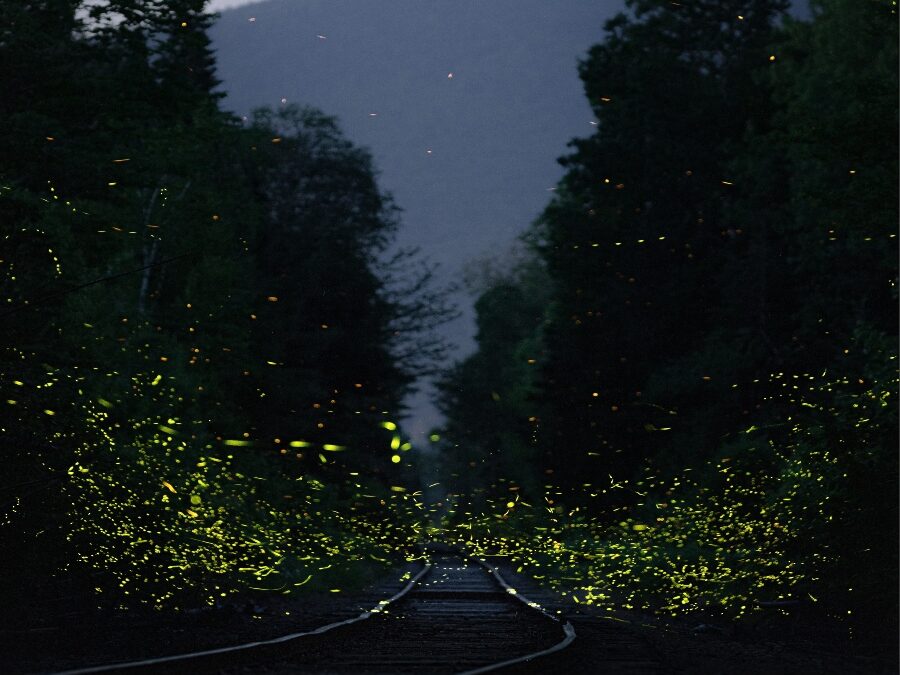
The secret to sin is to do it in secret. We learned secrecy young—two girls taught to swallow our hunger—so we meet up at nightfall once the last lights have gone out. We walk down the roads, cursing this town full of coal-miners and farmers and churches, cursing the way we’ll likely never leave. The air is petrichor-stained, and we’re led only by the humming streetlights and starlit sky. We find each other at our meeting place, the lake south of me, north of you, me scrambling over the wet rocks toward the grove where you’ve lain down the knit blanket. And as soon as we catch each other’s eyes, we’re each saying Here is my shirt, here is my hair, my hands, my mouth, take it, take me, right now. Your eyes glow like lightning bugs, jaw sharp as my pocket knife. As we strip, our breaths turn to fog, the cool drizzle falling onto your curls and half-shut eyelids. Your thighs shear mine—the seawater taste of skin, the scrape of teeth against lip, fingertips meandering down spines, tracing mandibles. Breaths a windstorm—some desire to rub ourselves together till we make some sort of fire. As your mouth latches onto skin hardly anyone has seen, rosy even in this low light, we gasp like people drowning, and I try to think of a word for the way I want you—wildly, maybe. Like a monsoon. But what’s at first erotic erodes: love collapsing like the hills that gave way after so much rain and mud last winter. And so much want is sinful—I know—so we’re wary of the fires and floods, lying together only in darkness, water spattering our faces, swallowing what we can of each other.
Originally published in Prairie Schooner
by Kristina Saccone | Dec 23, 2022 | flash fiction
It was our first once-a-month grandmother-granddaughter date at the JCC. I hopped on the treadmill while you did Jazzercise, all ladies over the age of 60 – or maybe 70, but at the time, I couldn’t tell the difference – and one man, Norman. Ink blots on his bare head, pants up to his ears. The ladies laughed in the locker room about his little grunt each time he leaned on his
right foot. They said it sounded like their husbands trying to come. You sat there with them, all of you naked from the waist-up, folds of silly putty skin rolling over a couple of ragged surgery scars, some galaxy-size stretch marks, and one larger-than-tarantula wine-colored mole above a pale, lumpy buttock. You talked like old friends – though you said you barely knew any of them –breasts resting on their stomachs, thighs, towels wrapped around their waists, giggling about Norman as though at an afternoon klatsch, fully dressed neck to ankle.
I watched this with my robe tied shut, in wet shower shoes, shielding myself with the locker door, mortified by all that skin and laughing and wetness and unadulterated fat. At the time, I was worried about the guy I was dating, his obsession with an ex, whether he fucked me for fun or to forget her. When you mentioned my “mysterious man” to the ladies, they turned their fleshy bodies at me and poked for details. I showed them Trey’s Match.com photo, and
their crooked fingers reached for more detail. They cooed over it, but you, you never minced words. You said, “No matter how pretty they look now, they all turn into Norman one day.”
I stepped behind the shower curtain and let the robe slide off, water rolling off my belly. Trey’s ex – or so he said – had a flat tummy and round butt, but mine was curvy, channeling suds from the crease between my breasts to my belly button until the soap disappeared. I got out of
the shower with nothing but a towel on my head. Until then, I had never been naked in front of anyone but boyfriends or the doctor – no, not even in front of Mom, not since I grew breasts–but you and your friends didn’t blink because I was just one of the ladies.
Norman winked at us on our way out the door. I left a voicemail for Trey in the parking lot, not sure I wanted him to call back, before we picked up pastries and ate them in the car, buttery flakes crumbling all over our laps.

by Iona Rule | Dec 20, 2022 | flash fiction
You meet him at your niece’s birthday party, where the kids run feral, coked-up on pink juice and icing. While he performs his act, your sister is with her mum friends, drinking warm wine in the kitchen and whispering loudly about that mother in the PTA. The men are outside, comparing their latest acquisitions: BBQs, lawnmowers, mistresses.
He makes balloon animals, a menagerie passing through his hands. You watch the deft way his fingers move, creating knots and curls, producing life from nothing. The children request eagles, frogs and unicorns, which he produces with an effortless flourish. He asks you what animal you would like. You look into his whitewashed face with its scarlet smile and diamond eyes and reply
“A hedgehog”
because you’ve never been easy and spending time with your family makes you bitter. He keeps smiling and creates a dolphin, presenting it with a comical bow. It’s not even close.
“I will practise,” he says, which may be the kindest thing anyone will say to you today. You want to tell him that a group of hedgehogs is called an array, but that you have never seen a group. You have only ever seen one.
You take him to a bar after and ask if he’d like to take off the face paint and the oversized rainbow dungarees. He says he’s comfortable as he is, and you’re relieved. You order a Negroni, and the ice cubes click against your teeth with each sip. He tells you about his family. You expected fire-eaters and acrobats and are disappointed when he talks of a plumber and a librarian. You tell him about your parents, how you always wanted to be different but never quite managed.
That night you take him home. You undo his bow tie and remove his blue bowler hat, but ask him to leave his face paint on. As you have sex, you stare into his face, which is always smiling, and wonder if it could always be like this. In the morning, after he leaves, you apply your lipstick, moving the crimson paste beyond your lip line, curling up the edges in a permanent grin.
You meet your lover, the clown, every Thursday. He smells of grease paint and candyfloss. He always comes in costume, straight from a shopping centre opening or a circus audition. Every time, you ask him to leave it on. It amuses you to think that you may be passing your lover on the street or the bus, and never know it. That you have never seen his real face.
The last time he comes over, you tell him you’re ready and ask him to take off the mask. But he won’t.
“You never take off yours,” he says.
He kisses you, smearing paint on your face, below your eye, like a tear, ties his red shoes, and leaves.
You find the gift he has left on the bedside table. A balloon animal. The hedgehog he promised, and beside it, a pin. Because he knew you so well, after all.
by Fractured Lit | Dec 16, 2022 | contests


fractured lit anthology 3 prize
judged by Peter Orner
CLOSED February 19, 2023
submit
Showcasing today’s best flash fiction writers. $5000 awarded between 20 finalists. Submissions are open for The Fractured Lit Volume 2 from December 20 to February 19, 2023. This year stories will be selected by Peter Orner, who will choose 20 winners from a shortlist of 40 stories.
Peter Orner, a two-time recipient of the Pushcart Prize, is the author of six books, including the novel LOVE AND SHAME AND LOVE and the collection ESTHER STORIES, a finalist for the PEN/Hemingway Award. His memoir AM I ALONE HERE? was a finalist for the National Book Critics Circle Award. His fiction has appeared in The Atlantic, The Paris Review, Tin House, and Granta and has been anthologized in The Best American Short Stories. The recipient of the Rome Prize, a Guggenheim Fellowship, and a Fullbright to Namibia, Orner holds the Darmouth Professorship of English and Creative Writing at Dartmouth College.
Fractured Lit is looking for flash fiction that lingers long past the first reading. We’re searching for flash that investigates the mysteries of being human, the sorrow, and the joy of connecting to the diverse population around us. We want the stories that explode vertically, the flash that leaves the conventional and the clichéd far behind. Fractured Lit is a flash fiction-centered place for all writers of any background and experience.
Good luck and happy writing!
guidelines
- Your $20 reading fee allows up to two stories of 1,000 words or fewer each per entry-if submitting two stories, please put them both in a SINGLE document
- We allow multiple submissions-each set of two flash stories should have a separate submission accompanied by a reading fee
- Flash Fiction only-1,000 word count maximum
- We only consider unpublished work for contests-we do not review reprints, including self-published work
- Simultaneous submissions are okay-please notify us and withdraw your entry if you find another home for your writing
- All entries will also be considered for publication in Fractured Lit
- Double-space your submission and use Times New Roman 12 pt font
- Please include a brief cover letter with your publication history (if applicable)
- Submissions are not limited to writers in the US. All English-language submissions are welcome.
- We do not read blind. The judge will read anonymously from the shortlist.
20 PUBLISHED AUTHORS WILL RECEIVE
- $250 award
- Publication in the print edition of our 2023 Anthology
- 5 Contributor’s copies
Some Submittable hot tips: – Please be sure to whitelist/add to contacts, so notifications do not get filtered as spam/junk: notifications@email.submittable.com– If you realize you sent the wrong version of your piece: it happens. Please DO NOT withdraw the piece and resubmit. Submittable collects a non-refundable fee each time. Please DO message us from within the submission to request that we open the entry for editing, which will allow you to fix everything from typos in your cover letter to uploading a new draft. The only time we will not allow a change is if the piece is already under review by a reader.
OPTIONAL EDITORIAL FEEDBACK: You may choose to receive editorial feedback on your piece. We will provide a global letter discussing the strengths of the writing and the recommended focus for revision. Our aim is to make our comments actionable and encouraging. These letters are written by editors and staff readers of Fractured Lit. Should your story win, no feedback will be offered, and your fee will be refunded.
Good luck and happy writing!
submit

Recent Comments