
by Noémi Scheiring-Oláh | Sep 28, 2023 | micro
When the birds go quiet, the girls stop walking. The air around them is glassy and pale, like a glass of milk their mother used to pour every morning: half milk, half water.
When the birds go quiet, the girls can hear their own breathing: quick and light like cat paws in the snow. The right kind of breathing, their mother used to say, Doesn’t attract flaring wolf-eyes on your frail figures. The right kind of breathing, their mother tapped her upper lip with a finger, Is hazy and blurred, like ghosts merging with the walls.
But when the birds go quiet, there are no walls around the girls. Only the wide hips of an oak and it’s naked, open arms glinting in the moonlight, ready to receive their offering. The girls remove their hoods and look at each other. Their faces glow like fire. Fierce. Determined. A feast for the eyes, a shadow in the woods growled at them once, when they treaded off-path to look for their mother.
But when the birds go quiet, their mother is nowhere. There are only the wool-wrapped girls, and the oak, and the budding, hungry leaves. Now, it’s their turn to feast.
When the birds go quiet, the girls kneel by the oak’s feet and start digging. They dig faster and faster, letting grains of dirt burrow under their nails. They take big gulps of breaths, inhaling the soil’s cool scent that guides their hands deeper and deeper.
The birds stay quiet when one of the girls stops and sits back on her heels. The other loosens a red coat around her waist. They found the coat four days ago, hanging from the oak’s branch, missing their mother’s body. The girl slips a hand inside the coat, over her heart, and pulls out a bundle wrapped in table cloth. The fabric is soaked in blood. The other girl reaches out. Her soil-kissed fingers unwrap the dripping package. Together, they shake it out, dropping a long, clumped, clotted wolf-tail – chopped off.
As they bury the hole, the birds stay quiet. The girls bow to the ground and put their ears to the fresh lump of earth, listening to the oak’s roots.
While the birds stay quiet, the girls can hear the roots stretching, growing, feeding.

by Fractured Lit | Sep 28, 2023 | news
51 stories made it to your longlist for this contest! Thank you all for trusting us with your writing! We’ll be narrowing down our Shortlist of 25 for Judge Sara Lippmann’s review!
- Pairs
- possible future for our daughter #683
- Rowdy Yates Slept Here
- Roadkill
- Is Now and Ever Shall Be
- Narrative Therapy
- Nothing in Life
- For a Short Time Only
- Vandals
- Deliverance of Grief
- Sweet Tooth
- If we name it Mittens, can we please keep the food delivery bot, please?
- Missed Shifts
- The Kaiser’s Bullet
- To Be More Than a Good Daughter
- A Skeptic’s Guide to Post-Apocalyptic Cosmology
- Between Water and Sky
- Void
- Up in the Rafters
- Afterwards
- Fruit Salad
- Red on Yellow
- One Day on the Gaspé Peninsula
- After Sabbath, Now Laugh
- We Mistakenly Think It Keeps Growing
- Unwrecked (Notes on Year IV in the Deep Caribbean)
- Candied Lemon
- For You Page
- Intertidal
- In All The Loveless Places
- My Mother, the Water Monster
- The Girl Made of Dirt
- Last Wish
- Bespoke Birth Chart Baby – a Modern Fable
- The Potato Field
- Piel Muerta / Dead Skin
- Rosie and the Wolf
- Cheerful
- Looking Up
- Shikar (The Hunt)
- Hatching Moths
- Stanislavski’s Fly
- Four
- Fullness
- To the Next Tenant, I Have Left
- The Bad Ones
- The Littlest Krampus
- How About Not
- Snagging Blanket
- Mouthful
- Eulogy

by Myna Chang | Sep 25, 2023 | micro
It was the night Johnny came back to town, one of those pent-up summer nights when the sky trembled heavy with unshed moisture, weighing us down, the burden of it pressing us into the dust, and we wanted to scream let go! but heaven wouldn’t unleash that water, held it fist-tight, just out of reach, pushing the young people to burst and the old people to beg.
Someone said Johnny came in on the bus, he hitchhiked, Johnny cruised into town in a candy-apple Mustang, sweet as punch. He stood in his momma’s driveway, outside the diner, on the tracks by the overpass. Someone saw him walking down Main Street, eddies of powdered grit swirling in his wake.
It was the night of the harvest moon, beams breaking through the clouds, spotlighting the wheat stubble, casting shadows sharp across the shredded stalks and the ruts. Johnny bought a six-pack at the gas station, a fifth of bourbon at the liquor store, a coffee at the donut shop, paying whatever he had for a chance at deliverance.
They said he’d been working on an oil rig, he’d enlisted in the army, he’d gone to California. Johnny followed the rain to places made of more than dirt, where droplets flew wild in the night, free from sacrifice and prayer. He’d gone to swim in the ocean, to wade in a creek, to dive headfirst into an impossible pool of crystal blue. They said he’d gone to make his way.
It was like so many other nights when the sky teased, and the ground ached, like so many other Johnnies caught in the between, consumed. We heard he lost an arm in a thresher, he shot a man in Tulsa, he struck it rich in Vegas. Johnny came home in a leather jacket, a three-piece suit, a star-striped box. His momma didn’t cry, but his daddy did, standing smack in the middle of the VFW parking lot, the high school parking lot, the Methodist parking lot, salting the hardpack earth under that brutal moon, bargaining with that bitter sky.
It was the night we searched everywhere, hoping to see Johnny around the next corner, wondering if our own sky would ever let go, or if we, too, might burst before we made our way through the drought.
Originally published in Middlehouse Review.
by Pamela Painter | Sep 22, 2023 | flash fiction
We’re having a late lunch, five women, widows now, who have been meeting once a month for forty years. “Dress-up time” we call it because when you are our ages—86, 87, 91, and 93– few events encourage one to don a cape, drape a rope of pearls around a neck, or apply eye shadow if the 2 X mirror cooperates. Of course, there are concerts, plays, the opera– and the ballet, though only Lillian appreciates that silly art. For funerals, our “little black dresses” have long since acquired little black sweaters. Grace calls them our cremation wardrobe. In truth, she only said this once, but it caused such dismay that we left a far smaller tip than usual.
Years ago, after our husbands died in person, and died again in tedious conversations describing their various illnesses, we unanimously agreed to never talk about medical concerns, prognoses, medications, or. The exception –if one of us is in the hospital where such a stricture would be burying our heads in the sandbox.
But there’s always much to talk about: deliciously snarky reviews of undeserving prize-winning books, TV series watched or slept through, the trials, tribulations and rare successes of our children, the trivial exploits of grandchildren. Their occasional weddings and frequent divorces. The absence of men. This last from Olive, though always soon dropped when someone says, “What men.”
Tonight, I am trying to decide which Roads Scholars Cruise to take– the smaller ship perusing the stunning Alaska coast, or the elegant barge that traverses the peaceful Seine. I would welcome any of the assembled friends as a roommate but when I leave to use the Ladies, I suspect that for sure someone will recall sotto voce my propensity for snoring.
Toward dessert, we catch up on recent unpleasantnesses. We insist on this gentle word. Today Olive laments that in a moment of weakness, she gave her meddlesome daughter-in-law her rope of heirloom pearls. Her hand flutters above the plateau of her ample empty chest. “I thought there was something missing,” Kelsey says, causing Grace–of the cremation wardrobe remark– to remark that, given the predictability of the future, at some point, we will all be missing. Oh, that Grace.
Surely one at a time, I offer. A weak offering. After a pregnant silence, we summon the waiter and order a third bottle of vintage wine.

by Fractured Lit | Sep 18, 2023 | contests


judged by Morgan Talty
September 24 to November 19, 2023 (CLOSED)
submit
Thank you to everyone who submitted to this contest! We’re busy reading every submission! We announce a longlist in 12 weeks!
We’re back with our fourth anthology, and we can’t wait to read your stories. We didn’t pick a theme for this contest because we want to revel in the deeply dynamic imaginations of our fantastic submitters. Each year, you wow our readers by writing the stories that only you could write, and we’re honored to give these stories a platform to introduce them to our dedicated readers who love flash and microfiction as much as we do. Challenge the status quo and surprise us with your unique characters, your specific settings, and your intriguing conflicts.
Showcasing today’s best flash fiction writers. $5,000 awarded between 20 finalists. Submissions are open for the Fractured Lit Anthology Volume 4 from September 24 to November 19, 2023.
This year stories will be selected by Morgan Talty, who will choose 20 winners from a shortlist of 40 stories.
Morgan Talty, a citizen of the Penobscot Indian Nation, is the author of the nationally bestselling and critically acclaimed story collection Night of the Living Rez from Tin House Books, which won the New England Book Award, was a finalist for the Barnes & Noble Discover Great New Writers, and is a finalist for the 2023 Andrew Carnegie Medal for Excellence in Fiction. His writing has appeared in Granta, The Georgia Review, Shenandoah, TriQuarterly, Narrative Magazine, LitHub, and elsewhere. A winner of the 2021 Narrative Prize, Talty’s work has been supported by the Elizabeth George Foundation and National Endowment for the Arts (2022). Talty is an assistant professor of English in Creative Writing and Native American and Contemporary Literature at the University of Maine, Orono, and he is on the faculty at the Stonecoast MFA in creative writing as well as the Institute of American Indian Arts. Talty is also a prose editor at The Massachusetts Review. He lives in Levant, Maine.
Fractured Lit is looking for flash fiction that lingers long past the first reading. We’re searching for flash that investigates the mysteries of being human, the sorrow and the joy of connecting to the diverse population around us. We want stories that leave the conventional and the clichéd far behind. Fractured Lit is a flash fiction-centered place for all writers of any background and experience.
guidelines
- Your $20 reading fee allows up to two stories of 1,000 words or fewer each per entry-if submitting two stories, please put them both in a SINGLE document.
- We allow multiple submissions-each set of two flash stories should have a separate submission accompanied by a reading fee.
- Please send flash fiction only-1,000 word count maximum per story.
- We only consider unpublished work for contests-we do not review reprints, including self-published work (even on blogs and social media). Reprints will be automatically disqualified.
- Simultaneous submissions are okay-please notify us and withdraw your entry if you find another home for your writing.
- All entries will also be considered for publication in Fractured Lit.
- Double-space your submission and use Times New Roman 12 (or larger if needed).
- Please include a brief cover letter with your publication history (if applicable).
- We only read work in English, though some code-switching is warmly welcomed.
- We do not read anonymous submissions. However, shortlisted stories are sent anonymously to the judge.
- Unless specifically requested, we do not accept AI-generated work.
The deadline for entry is November 19, 2023. We will announce the shortlist within ten to twelve weeks of the contest’s close. All writers will be notified when the results are final.
Some Submittable Hot Tips:
- Please be sure to whitelist/add this address to your contacts, so notifications do not get filtered as spam/junk: notifications@email.submittable.com.
- If you realize you sent the wrong version of your piece: It happens. Please DO NOT withdraw the piece and resubmit. Submittable collects a nonrefundable fee each time. Please DO message us from within the submission to request that we open the entry for editing, which will allow you to fix everything from typos in your cover letter to uploading a new draft. The only time we will not allow a change is if the piece is already under review by a reader.
OPTIONAL EDITORIAL FEEDBACK:
You may choose to receive editorial feedback on your piece. We will provide a two-page global letter discussing the strengths of the writing and the recommended focus for revision. We aim to make our comments actionable and encouraging. These letters are written by editors and staff readers of Fractured Lit. Should your story win, no feedback will be offered, and your fee will be refunded.
submit

by Kati Fargo Ahern | Sep 18, 2023 | flash fiction
On the line, I run a double-forklift. It’s a lot like a regular forklift, but the forks both spread out on either side and when they fan out, you have to catch the grooves of both pallets just so at the same time. And you have to do it FAST. Also, the balance point is trickier, especially if your pallet is stacked high with empty plastic disks that won’t get blown out from forms into bottles till later down the line. The disks weigh nothing, and it is a lot harder than it sounds. Also, on line 5, I work the robotic arms until they stop working, and I call the engineer.
When we are at work, Eugene talks about fantasy sports and the gun he has tucked away in his car. Anthony talks about superhero comics. Greg got so high he ran a forklift off the loading dock and needed a drug test and a lawyer. Anthony died last week at age 43.
At home, my daughter screams in the middle of the night if she has to cough or needs to pee. She plays with He-Man figures and My Little Ponies that we saved in a box for her. My wife gets drunk on boxed wine that saves for 30 days, but she has a hard time making it stretch for three.
At night, when my wife takes a shower, she meticulously swipes the edge of her razor blade against the bar soap because sometimes she gets mad and cuts herself. One time, the bleeding on her wrist didn’t stop for four days. But she doesn’t want to get flesh-eating bacteria from a warm, wet razor blade, so she cleans the blade against the soap. It creates deep, angry, soft grooves. The news says flesh-eating bacteria may be in all 50 states. Sometimes, she just showers, opens the door, and watches the paint peel on the ceiling because the fan doesn’t work. Other times she shampoos and washes and then flicks four, quick strokes against her skin so they look like bloody-beaded, five-lined music. Beyond a doubt, but full of hesitation.
When I am at work, I need to take a 15 minute break that my partner will cover. But my partner is so slow that I need to get him set up for my break so we don’t get behind. I sit in my car and watch videos on my phone and eat a sandwich light on the lunchmeat, heavy on the mayonnaise. When it’s hot, I need to turn the car on to run the AC. I dip my barbeque chips into the edge of my sandwich mayonnaise. I close my eyes and see the afterimage of line 5.
I have a friend who calls me when he’s driving across town to pick his family up Chinese takeout. We get 15 minutes or so of catchup on the kids, our wives, or some shows. Sometimes he tells me about some basketball or the latest fight. My wife says, “How’s Scott? How’s Joan?” and I don’t like to say because when our breaths are counted, we haven’t said that much.
My daughter has a hard time at school. She writes her name in a kind of cursive she made up with a snake coming off the “t” like a sort of balloon. The snake is smiling. She calls it “snakeish.” Her teachers tell us to let her do it. When she writes thank you notes or cards to my dad or my wife’s mom, we include a parenthetical. We neatly print her message or her name. We explain what she means.
When the robotic arms stop working, there are a few things I do before I call over the engineer. I can punch a few buttons in a sequence, and sometimes, he doesn’t have to come. When he comes over, he comes over like he thinks he’s a god. His steel-toed boots are specially made because one of his legs is noticeably shorter. He walks with a limp. He smirks like a turtle. His teeth are braces-straight where each tooth looks a little too blunted, a little too uniform. His breath smells like mustard.
North Carolina is a “right to work state,” which is the same as saying you have no rights to work at all. It’s steamy-hot in the summer, and the winter is a surprising mess of grey sleet and icy rain. There’s good music and good shopping. The people drive on I-40 like they’d never like to get home. Like they are driving 90 mph for their lives or just finding out. My wife and I would like to move away someday, but we can’t decide on where we’d go. Our dog is so old he wears diapers inside. Our daughter watches the same movie on repeat.
One of my wife’s friends holds a book club every month at her house. She makes themed food, and sixteen ladies act like they have read the book. When I come home, my wife is always holding a book but never reading it. She either grips things too tight or touches so gently it’s like bathwater. You’d wonder how she ever picks anything up. One time, her friend asked about me.
“Does Jake like to go out after work and share a beer with his friends on the line?”
My wife said she just blinked.
“I don’t think he has any friends on the line.”
If I’d been there when her friend asked, I’d have also said no. When I get home, I go to sleep. I touch my daughter’s toes to say goodnight. I count her breaths and wonder. The next day is almost ready to begin.
by Reneé Bibby | Sep 14, 2023 | flash fiction
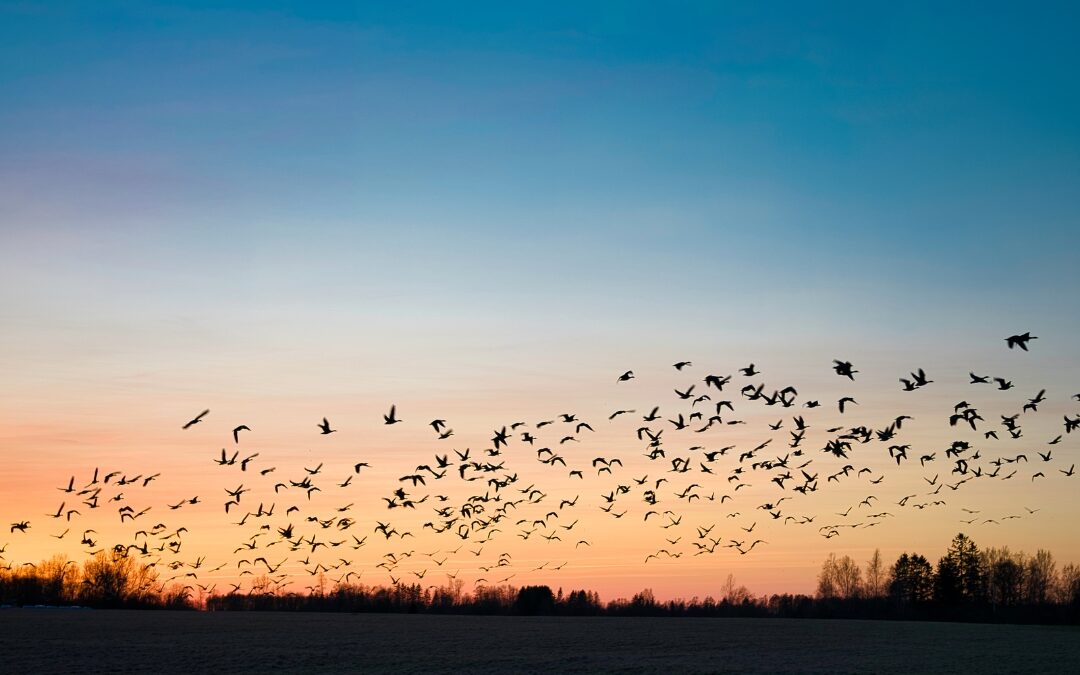
I stand at the kitchen window, calculating the parabolic arc a murmuration of birds makes against the ridge of conifers. He coalesces at my elbow, tipping his moon-face up to me, to the scratch of blue sky beyond the box of this house. No longer a boy-shaped smudge or a specter.
You’re supposed to find children charming—I’d learned that lesson early. Oh, other mothers would say, looking fondly at their boys, don’t you hate to send them off to school? I’m a blade that cuts—sharp, and kids are tender things, better that my boys were in classrooms or sports practices or running wild through the neighborhood with a pack of others.
It’s an unkindness now, some cosmic karma that in this new house I’d bought precisely because it suited just me, that I should have to put up with someone else’s kid. His little pit-pats sound as he moves around the place at all hours, energetic as a Tasmanian Devil, flicking on lights and devices, chattering, and peeping around corners as if I were more entertaining to watch than any nature program.
A hundred mental orreries of our orbits, but none of my calculations can predict when or for how long our worlds would pull far enough apart for there to be only pure and creamy quiet, only to spin into conjunction again so that we are shadows to each other. There is no calculus to solve the gravity that crashes us together, clear, solid souls in the same space.
I could say something now about the mechanics of how birds fly, and he’d hear me. He’d drink it, gulp it down like ice on a hot day. His eyes are their own creatures. They are alive in his face. They tremble. They are braced for a boo! The whole of him is braced.
His mother had called from the kitchen, “What’s that goddamn song you’re humming?”
I’d glimpsed his mother, too. Late at night alone at the kitchen table, hunched-back and hair loosening from a ponytail, or tying on aprons early morning as someone outside honks for her to hurry up. She is spilled gasoline. She is the slick-black of his life, the lung-searing choke, and the shimmer of fumes that begs for the tiniest sparkle to ignite.
I do not understand the physics that binds me here. What purpose do I serve if I cannot snatch his words from the air to stop her from hearing his reply, “It’s the song the lady in my room sings.”
She is at his doorway, a scribbled face of rage, “Don’t you fucking talk about her. She’s not real!”
She’s looked right at me in the hall, she’s locked eyes with me entering the bedroom that used to be mine, she’s heard my humming, too.
“You’re humming, again,” he says, at my elbow. “What is that song?”
The impulse to maintain the charade of distance rises up in me, a tsunami. But we are not separate. I cannot save him from his mother—worse, I was the reason for her conflagration. So, I say, “I am contemplating elliptic curves, L-series, infinite numbers, and fixed points. I am thinking the art of solving the unsolved and dedicating your life to that which only exists in theory. Is the unfished work what keeps me here?”
He’s not like either of my boys, who would not have stood still for my philosophizing. He’s careful to be neutral and quiet, but the animals of his eyes have softened, delighted to finally hear me.
His joy at something so simple is unbearable to witness. I look away.
“What difference it would make if I solved anything unsolvable. Who would even know? Nobody but a little boy. I am watching birds and trees through glass because I can no longer be amongst them. And I am humming Toccata and Fugue in D minor. Because it is beautiful. But I don’t think you should hum it anymore where your mother can hear.”
He absorbs all of that with a tiny nod and turns closer to the window, strains to stand at the same eyeline as me, seeking the birds who have already fled, as I am the shadow bound to this house. Or is to the boy? A tender, trembling thing, who makes me wish for a body and warmth and presence again so that he might feel my hand brush the top of his head, down his shoulder to soothe every part of him that is burned and trembling and alive.
by Brett Biebel | Sep 11, 2023 | flash fiction
It was supposed to be chess club, but instead, it was Gambler’s Anonymous, and that’s what you get in Moline. That’s what you get in church basements. It might be fried chicken, or it might be stale donuts, and I should have left right then, but I didn’t. I stayed. I don’t know why I stayed. I wrote “Reg” on my nametag, which was maybe the first lie, and some guy was talking about basketball. He said that CBS music made him feel whole and complete and ready to bust through a wall, and he was going to listen to it tomorrow. He was going to watch every minute of every game he could. Every TV in his house was plugged in in the living room. He’d already called in sick. His heart rate was going to rise, and he would cry and scream ecstatically by himself, and it was going to be okay because he was a goddamn force of titanium will, and he swore. Swore to Christ. There weren’t going to be any bets.
It’s hard to describe exactly how the room reacted to this. You’re not supposed to judge, I guess. You could tell, though, people thought it was a real shit idea, and I sat there, trying to hide my face. Trying to hide it without putting anything in its way, and I smoked a cigarette with this guy, after the meeting. He called himself Bigby. He said, “You don’t look right,” and the air smelled all cold and refreshing and dead, and I thought about all kinds of possible responses. “Who does, though,” or “Fuck off, asshole,” or maybe just kind of walk off like that. Like a goddamn scene from Chinatown or whatever, and all this must’ve taken forever because Bigby dropped some ash on my boot. I looked up.
“Seriously, man, you look like shit.”
“Drowned rats,” I said.
“What?”
“I used to walk in the door after practice, and my mom would say that. ‘You look like a drowned rat.’ I never really think about stuff like that.”
“I don’t think about much of anything.”
“Because thinking is overrated, I bet.”
“Don’t bet.”
“All bets are off,” I said, and I also think I fucking winked.
Bigby shook his head a couple of times, and then he left like I should’ve, and I followed him, followed him all the way home. Safe distance. Laying back and letting these pickups tuck in between. His house was in that part of town by the interstate, and there was a lot of brick and lawns trying as hard as they could, and he had a big front window. You could see practically the whole first floor. There was a picture of Jesus and an Old Style sign, and the real obvious thing was there was not one fucking TV. A bookshelf. Christmas tree lingering. I thought about how maybe the screens were all in the basement or all under lock and key or some shit, and I don’t know, man. Something about March. Something about snowmelt. It asks some pretty fucked-up questions, and I drove home thinking about all of them. Lies upon lies, and all I remember is the lights of the Burger King. Maybe that French fry smell is the only thing true.

by Fractured Lit | Sep 8, 2023 | interview
Wolfsong (ELJ Editions 2023), Kathryn Silver-Hajo’s first full-length publication, is a gorgeous hybrid collection of flash fiction and CNF stories capturing formative moments in girls’ and women’s lives. There is pain in these stories. And longing. There are bad decisions. But there is also a remarkable fierceness in these girls and women and a deep wisdom, hard-earned. We respect these characters, we cheer them on, and we become invested in their journeys and outcomes. I had the great pleasure of speaking with Silver-Hajo about the collection, about writing (and knowing) strong women, character agency, the blurring of boundaries between fiction and CNF—and dogs. ~Diane Gottlieb
DG: You place the women in your stories in some very challenging, sometimes desperate situations, but you never paint them as victims. All your characters have agency, and they know it. How important was that to you?
KSH: It’s interesting. It certainly wasn’t conscious. I think it’s just intrinsic to my nature. I don’t believe in victimhood. I can remember situations where I was on a dark or isolated street, and I felt threatened. Instead of shying away, I would scream bloody murder or do something otherwise to make myself bigger rather than smaller. That’s who I am, so it comes through my characters as well. I didn’t want them to be victims, I wanted them to have agency. That’s very important to me.
DG: Did you have a lot of strong women in your life?
KSH: I’ve had a combination. I’ve had some very strong women in my life, and a few whom I would say were less in charge of their own destinies. That really bothered me, motivated me to be different. I do a lot of writing about family, either directly or indirectly, so some of those very strong women and even the more vulnerable ones are in there, usually finding ways to survive and thrive, to grapple with the difficulties they face.
DG: The collection is a hybrid of fiction and non-fiction stories—and you don’t tell us which is which! Do you sit down and plan to write either fiction or nonfiction? Is that choice in your brain before you put the pen to page?
KSH: Not necessarily. I think more frequently what happens is an idea or story comes to my head, something I know I want to write about. I don’t always know in the beginning if it’s going to come out as CNF or fiction.
DG: So, you’re surprised too. I imagine the distinction between fiction and non-fiction is not a critical one for you.
KSH: That’s very true. I love it when a journal has a prose category and doesn’t distinguish between the two. There’s more and more bending, or blurring of categories, more hybrid categories, and I love that.
DG: Your stories deal with some pretty serious subject matter, but I appreciate that there’s also humor in many of them. “A Changed Man,” for example, begins with this: “It was a year since Clementine had given Luke the boot. He was always crooning, ‘Oh My Darling, Oh My Darling.’ Air banjo on his knee, but he never cooked a meal, never put a dollar towards rent. So she rolled his duct-taped suitcase out the door, taking back his key.” I love that. I don’t know if younger readers among us will get the My Darling Clementine reference, but it certainly resonated with me—and made me laugh. How important is it for you to put humor in your work, and do you find it hard to pull off?
KSH: It’s very hard, for me. I love when I read humorous work, and my wonderful writing and critiquing buddy Mikki Aronoff is so good with humor. Her funny pieces always make me stop and think, “How did you do that?” So anytime I get a spark of something funny, I go with it. “A Changed Man” was written in a workshop with Meg Pokrass, and, of course, she’s really great with humor, too.
DG: Along with the touches of humor there is underlying sadness and longing in most of these pieces. “It Might Have Happened Like This,” comes to mind, a story where the narrator, a young woman tells of her 10-year-old brother’s horrific accident—and then rewrites history. Can you talk about that one a little bit?
KSH: Sure. That’s a CNF piece. My parents divorced when I was ten. That’s where some of the sadness that you sense probably comes from. My brother was from my mother’s second marriage, and the family never really fell back together as a cohesive unit after the divorce.
After my mother divorced her second husband, I was responsible for my brother when she was working. So there I was, the responsible adult, and then my brother had a serious accident. It was absolutely devastating. It was hard story for me to write, and a hard one for my brother to read.
DG: You told your brother about the story before it was published. Is that something that you do with most of the characters you write about?
KSH: No. I always try to write mindfully. I don’t want to hurt anyone’s feelings or go behind anybody’s back. On the other hand, I think as writers we have to be honest, have to be true. We have difficult stories to tell. Sometimes, my stories are straight fiction. Other times, I may take a factual element but fictionalize it, so it takes away some of the sting or stigma. And sometimes I just go for it and write straight CNF.
DG: There’s a sultriness to your writing, a sensuality, a mix of desire and danger, as in Three-Legged: “I might always have wondered how it would feel to touch your smooth chest slick with sweat in the still night, to hear your voice thrumming with want, feel your body vine around mine, fall into sleep already yearning for more.” I found myself wondering if you read a lot of poetry or write poetry?
KSH: Both. I have never formally studied poetry, but I love it. I subscribe to Rattle, which sends out a poem a day. I usually start my day by reading those. One of the things that attracts me to flash fiction is that it straddles that line between traditional prose and poetry.
DG: You write a lot about place as well. New Mexico appears in a bunch of these stories. And Lebanon. I especially loved “Snake, Taos, New Mexico,” which was nominated for Best Small Fictions, and “Banging Pots and Pans,” nominated for both a Pushcart and for Best American Food Writing. Neither of these two stories could have taken place anywhere else.
KSH: I lived in the Middle East and studied Middle Eastern history and languages. My husband’s from Lebanon, and we went back and lived there for several years after we both graduated. I have a very deep connection to the area, and my mother-in-law was one of those strong women you asked about, a very powerful woman—she’s in “Banging Pots and Pans.”
When my dad remarried, he and his second wife bought an old camper and drove out to New Mexico. They ended up settling in the mountains north of Taos and lived there until my dad died 15 years ago. So northern New Mexico is another deep influence in my life and is very dear to my heart.
DG: Kathryn, I love the title of the collection. How did you come up with Wolfsong?
KSH: So, none of the stories in the book is called Wolfsong, but you may have noticed that a number of them feature or have a dog in one guise or another. My little dog, Kaya, in spite of being cute and curly-tailed, can be quite fierce. Shiba Inu’s are hunting dogs, so she’s a huntress and can be ferocious and fearless but also extremely protective, loving, and tender, as can wolves. It struck me that this is also true of a lot of the female characters in the stories. They have all these different qualities, wolf-like qualities. Ariana Den Bleyker (the publisher) and I batted this idea around, and eventually, the concept and the name Wolfsong came together.
********
Diane Gottlieb, MSW, MEd, MFA is the editor of Awakenings: Stories of Body & Consciousness. Her writing appears in 2023 Best Microfiction, River Teeth, HuffPost, SmokeLong Quarterly, Hippocampus Magazine, The Rumpus, Chicago Review of Book, About Place Journal, and 100 Word Stories among many other lovely places. She is the winner of Tiferet Journal’s 2021 Writing Contest in the nonfiction category and on the 2023 Wigleaf Top 50 longlist. Diane is the Prose/CNF Editor of Emerge Literary Journal and the founder and author of WomanPause, a newsletter dedicated to lifting the voices of women over 50. You can find her at https://dianegottlieb.com and on FB, IG, and Twitter @DianeGotAuthor.
Kathryn Silver-Hajo is a 2023 Pushcart Prize, Best Small Fictions, and Best American Food Writing nominee. Her story, “The Sweet Softness of Dates” was selected for the 2023 Wigleaf Top 50 Longlist. Her work appears in Atticus Review, Bending Genres, Citron Review, CRAFT, Emerge Literary Journal, New Flash Fiction Review, Pithead Chapel, Ruby Literary, and other lovely places. Kathryn’s debut flash collection Wolfsong was published in 2023 and her debut novel, Roots of the Banyan Tree is forthcoming in the fall. She lives in Providence with her husband and curly-tailed pup, Kaya. Learn more at: kathrynsilverhajo.com; facebook.com/kathryn.silverhajo; twitter.com/KSilverHajo; and instagram.com/kathrynsilverhajo.

by Megan Callahan | Sep 7, 2023 | flash fiction
In science class, Margot teaches them about the magic of snow. “Evaporation, condensation, deposition,” she says. On the whiteboard she draws shapes connected by wiggly arrows. She’s tall and wiry, spine curved from decades of bending over small desks. Her face crumples like paper when she smiles or laughs. The kids like her white hair, her billowy floral dresses.
Margot peels open a cardboard box and distributes the musty contents: boots and wool socks; fleece-lined ski masks; colourful snowsuits with drawstrings at the waist. She leads them down the hall in a bumbling single file. Her own coat seems to swallow her; she hasn’t worn it in decades. “Gloves on,” she beckons. “Let’s go, zippity-zip.” At the end of the corridor is a plain white door. Cloud Lab, the sign says. Caution – Extreme cold.
The lab has milky walls and a high, vaulted ceiling. A digital thermometer reads -40℃. The children squeal and marvel at their misty dragon breaths. They race across the room, cheeks red as hibiscus petals. At the control panel, Margot twists a dial and punches in a code. A humidifier hums beyond the walls, pumping in air saturated with water vapour. Soon the domed ceiling is foggy with clouds.
“When I was little, we had blizzards.” Margot stamps her boots for warmth. “Clumps of snowflakes you could catch on your tongue.” Her students stare and blink. The word flake confuses them.
“Like cereal?” a girl asks
“No,” she laughs. “No.”
She talks of snow piling on rooftops. Burying cars. Three feet, five feet. Up to your waist! “We could swim in it,” she insists. They groan and roll their eyes. She reverse-twists the dial and the humidifier quiets. “We’d pack snow in our fists and build forts in the yard. Barrel down hills on flimsy plastic sleds.” Above them, the clouds grow like swirling cotton candy. “And the cold,” she exclaims, throwing up her hands. “It prickled like needles. Chilled you to the bone.”
One boy laughs, another pelts questions: Was it dangerous, the snow? Could you be smothered or drowned? They’ve never felt anything like the Cloud Lab before. Cold is for ice cream; AC in peak summer; lakes when you cannonball from sun-drenched docks. None of them know winter. None of them know bone-chilled. Margot bites her lip. She gropes for clear answers. Every year, she runs the experiment and tries to explain. Something is missing, something has been lost, but she can never find the words to describe why it matters.
And suddenly it’s snowing: a sprinkling, like confetti. The children fall silent. They squish shoulders and look up, captivated by the magic trick. Arms above their heads, mouths open, tongues out. Margot folds her hands and presses them over her heart. She remembers frost on windows, darkness in the street. And the rhythmic crunch-crunch of her father, shovelling.
“Touch it,” she encourages. “Each snowflake is different.” Her students catch flakes and slip-slide in their boots. They scoop up mounds and try to eat them before they melt. “More!” one girl chants, but Margot shakes her head no. The school has water restrictions: a strict weekly limit. But already they’ve lost interest. They complain about cold toes. Margot ushers them into the hall, where they immediately shed their layers. Snow puddles from their soles onto the speckled linoleum. Margot gathers their snowsuits. She unbuttons her coat. Somewhere deep inside is an ache that feels like homesickness, except she’s lived here her whole life.
Back in the classroom, the windows are open. The air is sweet and heavy with the scent of lemon trees. Along the road, the cacti bloom. Aeoniums reach for the sun.

Recent Comments