
by Timothy Boudreau
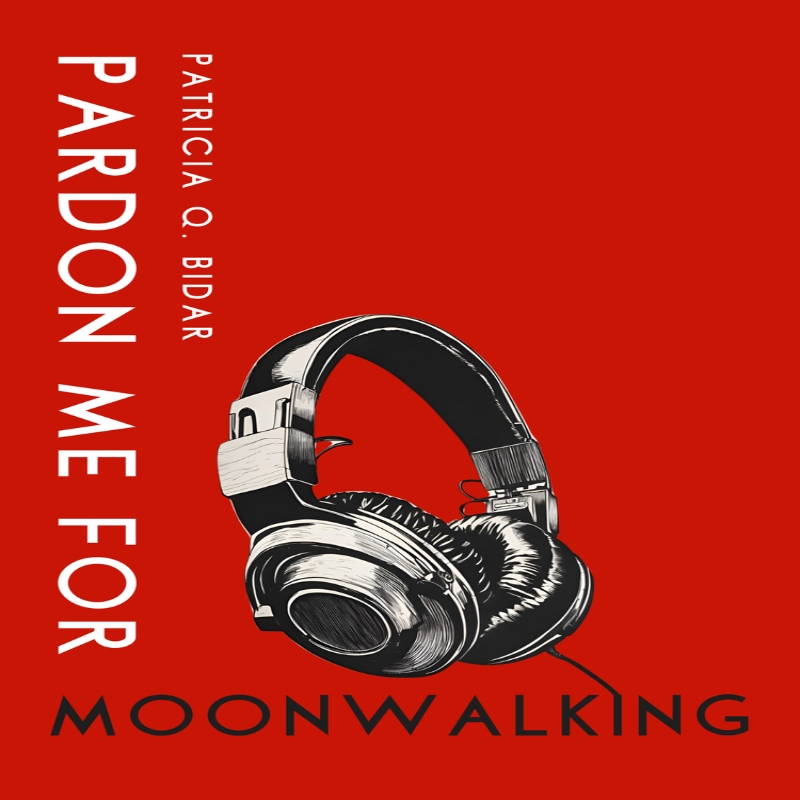
Patricia Q. Bidar’s Pardon Me for Moonwalking was recently released by Unsolicited Press. Get your copy HERE or wherever you buy books. Guest interviewer Timothy Boudreau recently met with Patricia for a lively exchange about the collection, Patricia’s first.
Timothy Boudreau: What are you proudest of in this collection? What did you learn from the process of putting it together?
Patricia Q. Bidar: I’m proud I became a writer again.
The stories in this collection are from my first four years writing flash fiction, in my mid-fifties. I began writing again after a long hiatus. As in, 20 years long. For me, it was raising kids while I worked full-time and also freelanced. I was stressed out and had lost touch with everyone I knew who was writing. Lost touch with myself.
So, putting the collection together gave me an astounding feeling. It meant I’d found teachers, devoted many hours to craft, and learned a bit about this phenomenal genre of literary writing. And then a dream publisher, Unsolicited Press, accepted it!
TB: How have your connections to the flash fiction community influenced and improved your writing?
PQB: Online classes and social media—particularly the brief but wonderful golden age of literary Twitter—help me connect with others near and far. I’d been publishing for a year or two when my story, Las Pulgas, came out in JMWW. It was like a seal over a spigot had burst. Because suddenly people were messaging me and sharing the story and saying they liked the work. Something had shifted. I felt like people knew me, and I, them. Around the same time, I had a story accepted by SmokeLong Quarterly. I have shared with, leaned on, uplifted, and learned from countless other writers since then. The flash fiction community provides a sense of camaraderie I have never before experienced. Connection to community is a big part of why I serve on staff at SmokeLong Quarterly and STORY Magazine.
TB: So many sentences leap out of these stories. “Your underpants cling to everything like starfishes.” How important in flash fiction is the succinct, vivid detail? How often does this exist in your early drafts?
PQB: The vivid details are often all I have in the first draft! An image in a film, a deeply felt emotion, or an overheard sentence spurs a draft. Never a theme or god forbid, a lesson. I revise to infinity. The idea that a work is finished is peculiar to me. Stories are alive. I tighten and deepen and re-work as long as I am still interested. Some fall by the wayside or are published and done. Others can’t shake me off!
TB: Many of your characters walk a knife’s edge between seeking security and wanting to “dare”—to choose recklessness, new experiences. How much of this dichotomy is intentional?
PQB: My brainy friend, I don’t know the answer to that. I’d say any recurring dichotomy is unintentional. But I can’t stay away from exploring freedom and trust; escape and anxiety.
TB: In this collection, characters at all stages of life struggle to create, redefine, or perhaps erase their identity. Tell us about how you create identity, and how that evolves as the story progresses.
PQB: I enjoy digging into the differences between what a character says and what they do. The difference between how that character sees themselves and how the reader sees them. Those blind spots are where depth and mystery reside.
What strategies did you use when arranging these stories? Is there a particular sequence that strikes you as especially effective?
PQB: I recently received advice to think of a collection as a museum show, with one room following another. Isn’t that great? However, my strategy with this collection was intuitive. I switched it up many times during the submission process.
TB: This book contains many memorable endings, final lines that seem just right, like, “A soft old couple together in matching recliners, a cat for each of our laps.” How do you know when an ending is “right”?
When you know, you know? I don’t always nail it. But I work hard on it, aiming for a landing that is beautiful but also feels both surprising and inevitable. It should depth-charge back into the piece and color its impact.
TB: “Going Public,” a much longer narrative than the rest, provides the collection with a powerful, satisfying conclusion. In a prior interview, you mentioned that you’re currently leaning toward longer forms. Which themes or types of story work better as flash? Which works better as longer pieces?
PQB: In grad school at U.C. Davis, I wrote and taught the short story. My own works from back then—Going Public is one of them, as is my novelette, Wild Plums—are very long! Sometimes it’s not clear at first whether a draft is flash or a short story. It comes down to scope and pace. It becomes clear as you progress. I look forward to a lifetime of learning about flash and about the short story form.
TB: What comes next for you, creatively? What are you striving for in your latest work?
PQB: I’m seeking a publisher for my second flash collection, which I’m absolutely in love with. It’s creative in that the sequencing and content are such an ongoing process. As for what I’m striving for, I’ve been in the cycle of drafting, revising, and subbing flash since 2017. I’m trying to be patient about which direction my work will take next. Thematically, and also in terms of form. I will always love flash fiction and will always write flash!
###
Timothy Boudreau lives in northern New Hampshire with his wife, Judy. His collections Love You, Miss You, Goodbye Forever (Stanchion Books) and Stepdad on the Dance Floor (Unsolicited Press) are forthcoming in 2026; his novel All We Knew Were Our Hearts (Unsolicited Press) is due in 2027. Timothy serves as an editor at The Loveliest Review. Find him on BlueSky at @tcboudreau or at timothyboudreau.com.
Patricia Quintana Bidar is a western writer from the Port of Los Angeles area, with ancestral roots in San Francisco, southern Arizona, Santa Fe, and the Great Salt Lake. Her work has been celebrated in Wigleaf’s Top 50 and widely anthologized, including in Flash Fiction America (Norton), Best Microfiction 2023, and Best Small Fictions 2023 and 2024. Patricia’ novelette, Wild Plums, is available from ELJ Editions; Pardon Me for Moonwalking (Unsolicited Press) is available now. Patricia lives with her husband, Trinidad, and their unusual dog outside Oakland, California. Visit patriciaqbidar.com or @patriciaqbidar.bsky.social.